
Case Study: A Chapter 11 Bankruptcy Left a University Holding More Leverage Than it had
This case-study highlights what every restructuring practitioner should understand about patent licenses in university-backed technology bankruptcies.

I am a 25+ year attorney specializing in patent licensing and monetization in whatever for that takes. Over the past few months, I have vibe-coded my way to understanding a recent Chapter 11 proceeding in the Bankruptcy Court for the Southern District of Texas. The punchline: the patent-holding university emerged from a §363 sale holding stronger IP rights than it did when the case began.
On April 9, 2026, Ascend Elements, Inc. (“Ascend”) filed for Chapter 11. At its peak, the company carried a $1.5 billion valuation with more than $1.1 billion raised from investors including Honda and SK On; as well as a federal DOE grant of $316 million. By the time the asset sales closed in July 2026, the buyers collectively paid roughly $3 million in cash to the estate for the patent portfolio, converted $138 million in contractor debt into a half-built Kentucky facility, and acquired an operating plant in Georgia for an undisclosed sum.
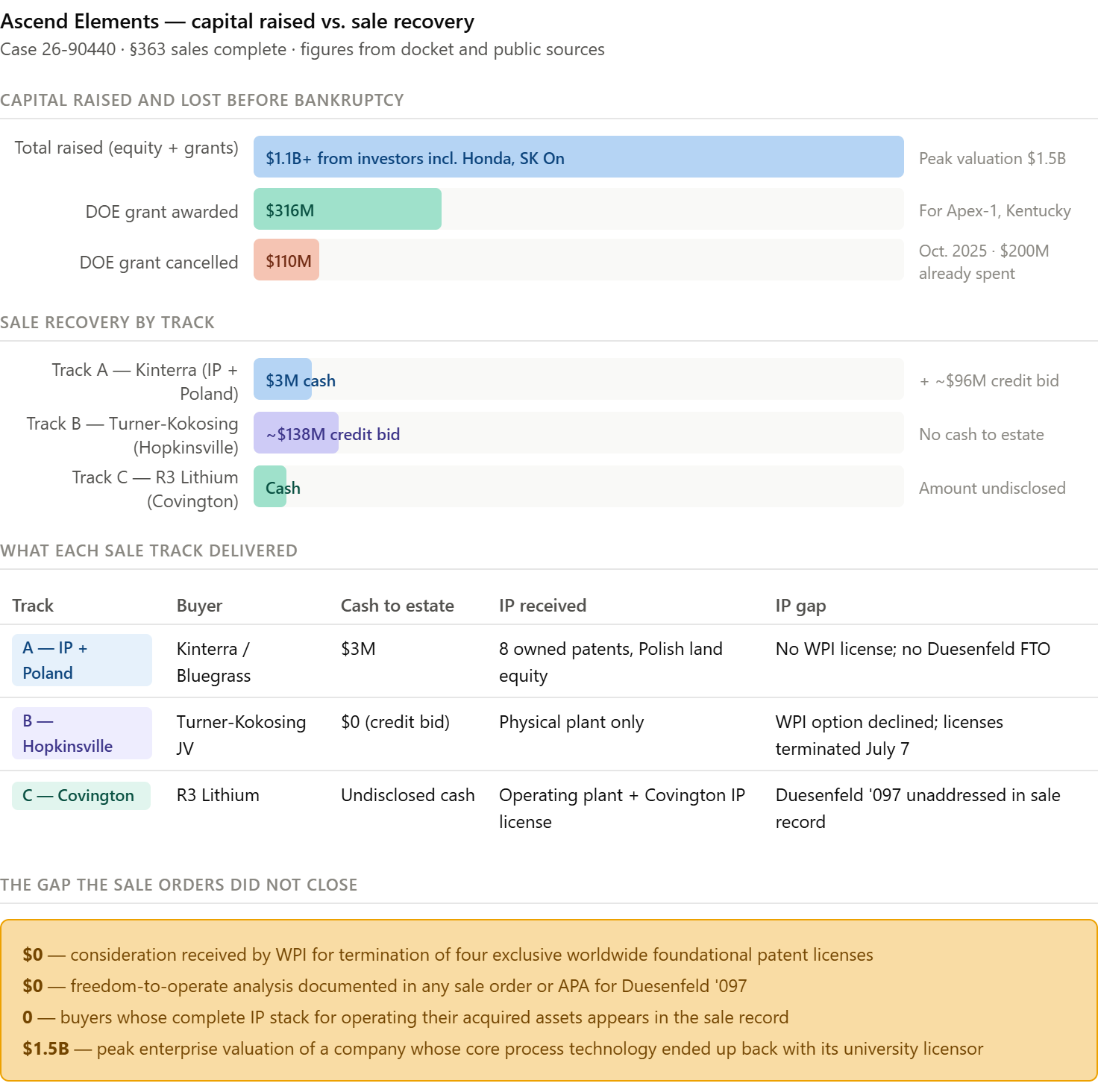
What nobody paid for was the freedom to operate.
To understand what ensued, is to understand university innovation and the exclusive patent licensing rights conferred by those institutions. This article explores the university licensor whose foundational patents underpinned the entire technology platform of a bankrupt company and subsequently emerged holding more negotiating leverage than it had before.
The structural lesson for practitioners
To begin, I want to be clear about what this case study is. It is the carving-out of a disputed license from a sale rather than litigating assignability on a compressed timeline. It is my limited understanding that this is standard restructuring practice. Credit bids are also routine. Deferring a §365(c) fight that would have delayed closing was arguably the correct call. The professionals in this case did what sale processes are built to do, i.e., close.
That is precisely why the case study matters. The IP gaps documented here were not produced by malpractice or chance. They were produced in the ordinary course of operating a well-run §363 process that is designed to transfer title efficiently. Regardless, it still needs to pass the smell test from experienced Patent Licensing professionals. This case is not a cautionary tale about one bankruptcy. It is an illustration of a structural gap that may exist in every §363 company asset sale that involves patents.
For background, a §363 sale order transfers title and extinguishes financial encumbrances. It does not convey patent licenses held by third parties. It does not resolve infringement exposure under patents owned by parties not in the case. It does not guarantee that the physical assets being transferred can be operated without additional patent diligence. And it does not eliminate the leverage of a licensor who withholds consent.
Every buyer in this case received a court-approved transfer of assets that were free and clear of financial encumbrances. Also, every buyer inherited the patent gap the order did not address. This case simply makes those gaps unusually visible because the docket is well-developed, the three-layer IP structure is clearly documented, and the university’s outcome is on the record.
The questions restructuring attorneys should be asking in every technology bankruptcy §363 sale are the same questions that went unanswered here:
What patents does the debtor own outright versus license from third parties?
Who is the actual licensee?
Are those licenses assignable without licensor consent?
What third-party patents cover the process or technology being acquired?
And whether anyone has rendered a freedom to operate opinion?
None of these questions are answered by reading the Sale Order. They require patent docket analysis, ownership chain tracing, and freedom-to-operate work that sits outside the standard restructuring diligence toolkit.
Three sales, three IP gaps
The Ascend bankruptcy produced three discrete §363 asset sale tracks, each closed by separate court order, each with a distinct buyer and consideration structure.
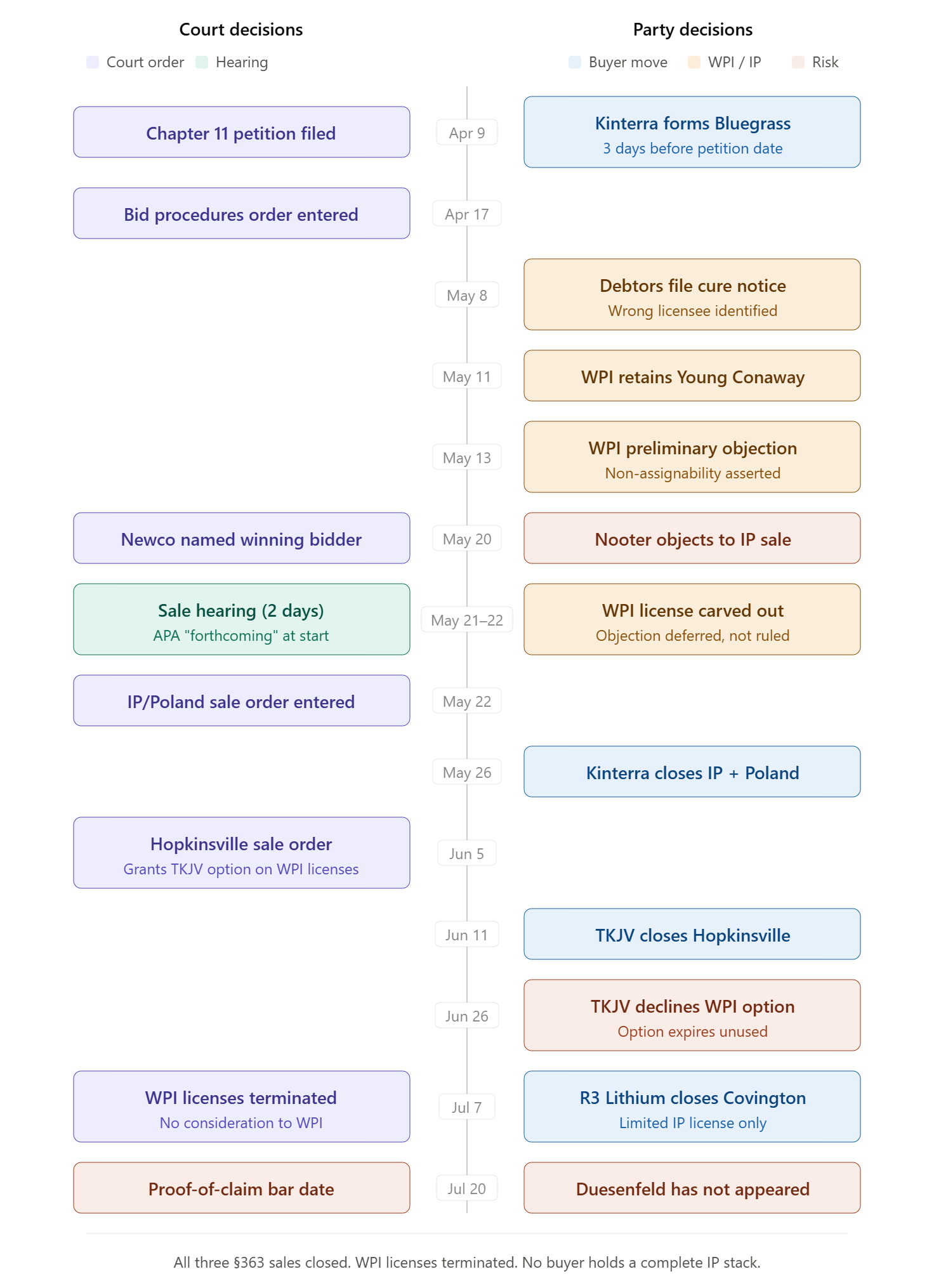
Sales Track A closed on May 26, 2026. Kinterra Capital Corp., acting through a newly formed vehicle called Bluegrass Infrastructure Partners Holdings, LLC, acquired Ascend-owned patent portfolio and its equity interests in Polish subsidiaries. It paid $3 million in cash plus a credit bid of convertible note obligations in an amount that remained “to be determined” as late as the Sale Hearing. The total stalking horse bid was reported at approximately $99.2 million, with roughly $96 million of that representing the credit bid component. The noteholders’ own debt served as the bulk of the purchase consideration. The objecting creditor RMF Nooter characterized the structure as insider self-dealing in the objection it filed (Dkt. 362), citing the noteholders’ consent rights over the sale process and their simultaneous position as buyer. The court entered the sale order after a two-day hearing. Whether the structure was improper was never adjudicated, so the objections were resolved through the order as entered, and the characterization remains Nooter’s.
Sales Track B closed on June 11, 2026. A design-build contractor (Turner-Kokosing Joint Venture) had filed a $138 million lien claim against the Hopkinsville facility it built and subsequently converted that creditor position into ownership of the same facility through a credit bid. No cash changed hands. Essentially, Turner-Kokosing acquired a battery recycling plant that was approximately 60% complete at the time of the bankruptcy filing that was built around a patented technology it did not acquire.
Sales Track C closed on July 7, 2026. R3 Lithium acquired the Covington, Georgia facility that is the only operating plant in the Ascend portfolio for cash. The sale documents included a “Covington IP License” granting R3 the right to use Ascend’s own technology. The key here is that pre-closing third-party patent claims were explicitly carved out of that license.
Three buyers. Three sale orders. Three patent gaps the orders did not close.
What the sale orders actually transferred
To understand the noted gaps, you need to understand the patent owner structure Ascend operated under, vis-à-vis Worcester Polytechnic Institute (“WPI”). There are three layers.
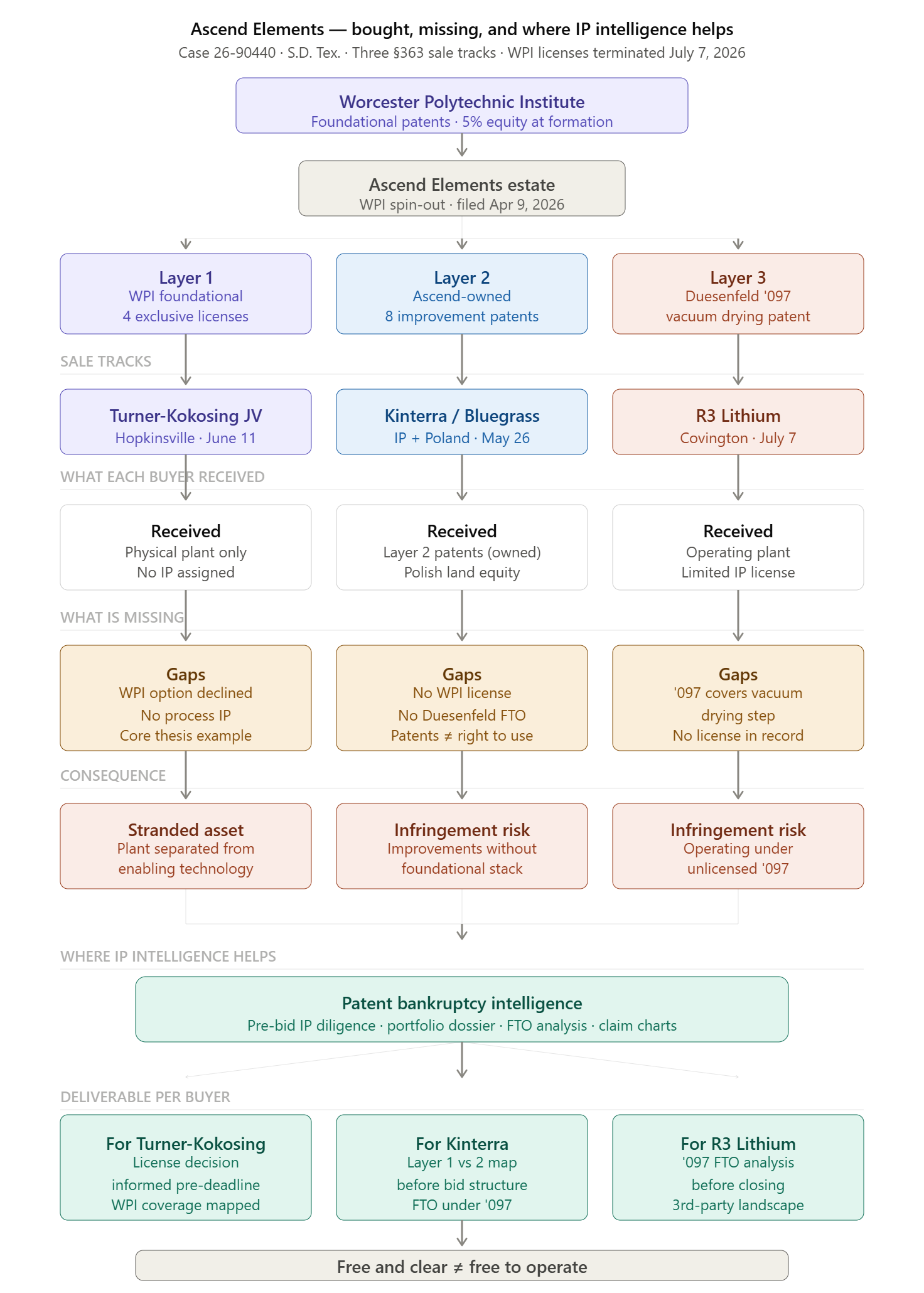
Layer 1 consisted of four exclusive worldwide license agreements with the university-owner, WPI, dating from 2016 to 2021. These exclusive patent licenses covered the foundational battery recycling technology that the Hopkinsville and Covington facilities Ascend operated under. It was not the party with WPI for the exclusive license. The exclusive patent rights, instead, were held by Battery Resources, LLC, a Massachusetts limited liability company (”Battery MA”) that was a subsidiary of Ascend Elements, Inc. Unfortunately, the Debtors’ own Assumption Notice misidentified Ascend DE as the licensee. Fortunately, WPI’s outside counsel identified the error and filed a preliminary objection (Docket 289) asserting, among other things, that the bankruptcy court lacked §365 authority to assign contracts of a non-debtor entity, i.e., Battery MA. And that even if it had such authority, federal patent law generally treats patent licenses as non-assignable without licensor consent. WPI did not consent.
The §365(c) case law on this point is not uniform across circuits, and exclusive licenses present their own complications, but WPI did not need to win that argument. Battery MA licensee issue stood on its own, and no party forced the question to a ruling.
Layer 2 consisted of eight granted US improvement patents owned outright by Ascend, covering hydrometallurgical process improvements and cathode precursor synthesis methods developed by Ascend’s own engineers. These eight patents were improvements to the university-owned patents. These improvement patents were cleanly transferred to Kinterra/Bluegrass as Acquired Assets under the Sale Track A.
And lastly, Layer 3 was entirely outside the bankruptcy proceedings. A German battery recycling technology company named Duesenfeld GmbH, holds US Patent 11,050,097 that covers a vacuum drying step used in lithium-ion battery recycling. The patent has been tested and has been upheld as valid under the USPTO AIA. Ascend’s challenged the validity of the ‘097 in both an inter partes review (IPR2024-00948) and a post-grant review (PGR2025-00037). Both challenges failed in October 2025, as did a parallel challenge by a German recycling equipment maker (Umwelt- und Recyclingtechnik GmbH (”URT”)) that sat on the Ascend creditors’ committee. Both losing challengers appealed to the Federal Circuit. Ascend’s appeal was stayed by agreement after the bankruptcy filing, but URT’s appeals continue. What this means is that the patented technology on vacuum drying step used in lithium-ion battery recycling is still being actively litigated by a third party with its own commercial reasons to knock it out. Unless and until the Federal Circuit reverses, the ‘097 patent stands, and no buyer in any of the three sale tracks obtained a license under it. I am unsure how this relates to the technology implemented by Ascend Elements at this time, but it’s worth noting for subsequent bona fide purchasers.
The sale orders transferred Layer 2 cleanly. They did not and could not transfer Layer 1. And unfortunately, they did not address Layer 3 at all.
What happens when the buyers try to operate
This is where the forward-looking questions become uncomfortable.
Kinterra holds eight US granted improvement patents and Polish land. The improvement patents build on WPI’s foundational technology. Without a license to the foundational Layer 1 technology, Kinterra holds patents that may be difficult to practice commercially. To use its own acquired patent in a manufacturing context, Kinterra likely needs a license from WPI. WPI is under no obligation to grant one, and now has no relationship with Kinterra at all. No license, no royalty, no contractual tie.
What happens if Kinterra moves to deploy the improvement patents commercially and the foundational technology they build on sits in a university’s portfolio with no licensing relationship in place? The docket does not show how Kinterra has addressed this. It may hold the patents purely as a financial asset, it may be negotiating with WPI privately, or the gap may be unexamined. The public record is silent, and the silence is deafening.
Turner-Kokosing presents the starkest case. The Hopkinsville Sale Order gave Turner-Kokosing the option to take assignment of the WPI licenses by June 26, 2026. Turner-Kokosing elected not to seek assignment. The WPI licenses were then deemed terminated by agreed order entered July 7, 2026 (Docket 546). Turner-Kokosing now holds a half-built battery recycling facility designed to practice a process technology it has no right to use, and which no longer has a licensee anywhere.
Two readings of that decision are available, and the docket does not choose between them. The first: Turner-Kokosing is a design-build construction joint venture, not a battery recycler. It bid a $138 million credit-bid to take control of a site it built and was never paid for. If its intent is to hold, resell, or repurpose the facility rather than operate it as a battery recycling plant, declining the licenses was entirely rational. If, on the other hand, it intends to operate it as a battery recycling plant or a subsequent purchaser has that intent, then we have an entirely different situation where the technology rights sit exclusively with WPI. And the second reading is the exclusive license question was a 21-day decision window inside a fast-moving sale process, and the option lapsed without the analysis it deserved. Whether the decline was a considered strategic choice or an unexamined gap is not visible from the public record.
The cleanest possible illustration of the thesis: a §363 sale order transferred title to a manufacturing asset. It did not transfer, and could not transfer, the patent rights that makes that asset commercially viable.
R3 Lithium operates the Covington facility that is the only going-concern asset in the portfolio and was producing battery-grade lithium carbonate at the time of sale. R3’s Covington Patent License is limited to the seller’s own technology, i.e., those of Ascend. Third-party patent claims were explicitly carved out. Duesenfeld’s ‘097 patent covers a vacuum drying step in the exact process R3 acquired. The patent has survived three validity challenges. The Federal Circuit appeal of the URT track continues.
What happens if Duesenfeld prevails at the Federal Circuit and turns its attention to the Covington operation following the bankruptcy proceedings? The sale record shows no Duesenfeld license, the seller disclaimed any warranty of freedom to operate, and the sale documents contain no representation that the acquired process is clear of third-party patents. What I don’t know is whether R3 obtained a license privately outside of the scope of these proceedings and then restructured the process to avoid the claimed steps, or concluded after its own analysis that the exposure is manageable. The docket does establish a narrower and still significant issue wherein the freedom to operate was not part of what the estate sold.
WPI: the unexpected outcome
What could have been the result of this Chapter 11 proceeding, WPI faced the prospect of a forced exclusive assignment of its foundational patent licenses to an unknown buyer that it had not vetted, had no contractual relationship with, and had not consented to. WPI’s objection raised three independent grounds for blocking assignment: the wrong party was the licensee, federal patent law prohibits non-consensual assignment of patent licenses, and no adequate assurance of future performance had been demonstrated.
Here is the counterintuitive result that deserves more attention than it has received.
The bankruptcy was resolved with WPI receiving zero consideration for the termination of four exclusive worldwide irrevocable patent licenses that had long durations running through 2036 or the expiration of the subject patents, some of which extend to 2043.
WPI now holds unencumbered, exclusive worldwide rights to foundational lithium battery recycling technology with no licensee, no royalty obligation running in any direction, and no commercialization duty owed to anyone. The Ascend bankruptcy effectively cleaned up a complicated exclusive license situation that had produced no commercial royalties and returned WPI to the position of a clean licensor with a valuable portfolio. And herein is the lesson benefitting the university licensor.
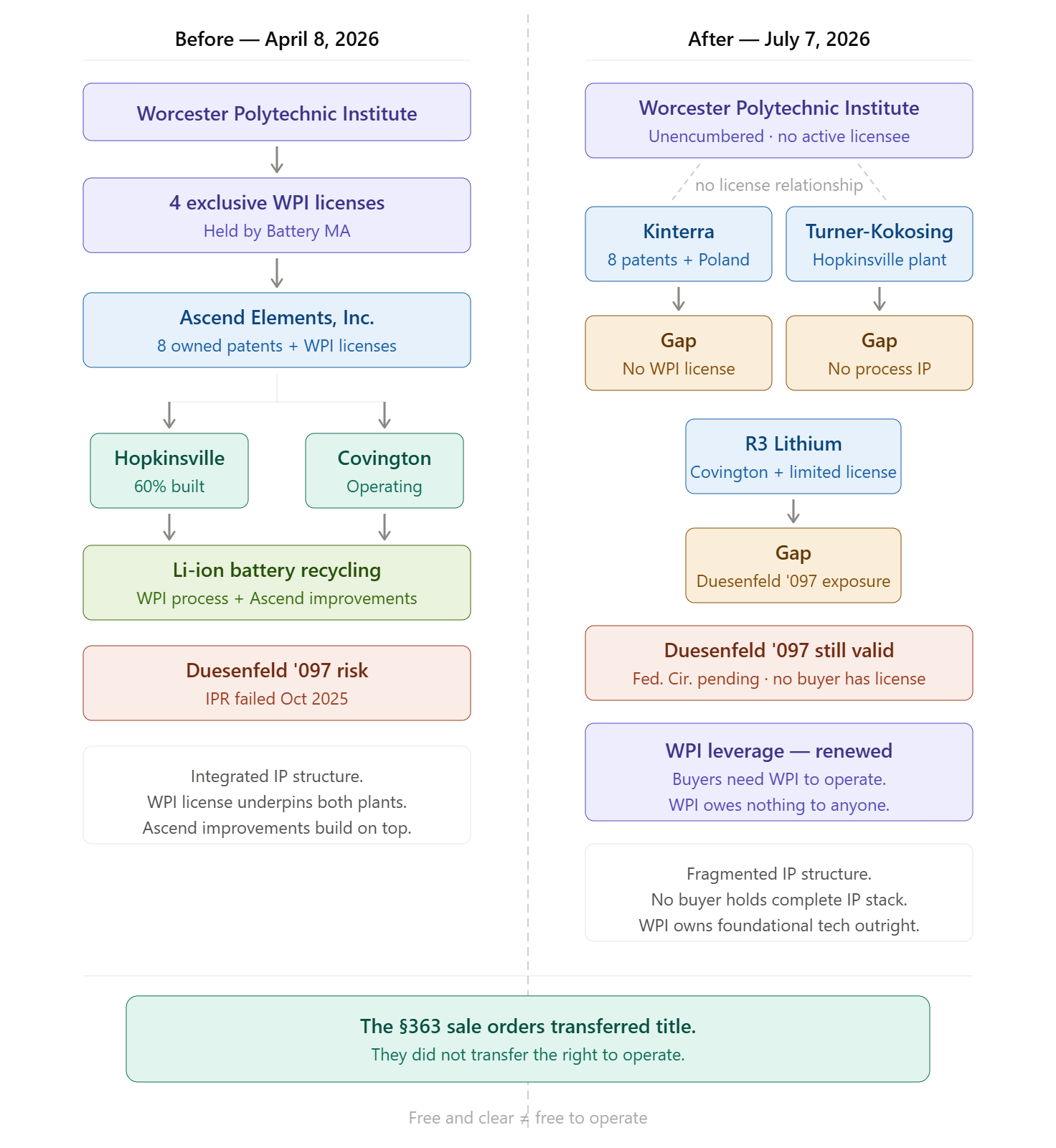
More importantly, Kinterra holds improvement patents that build on WPI’s foundational technology. To the extent Kinterra intends to practice those patents commercially rather than hold them as financial assets, the foundational rights sit first with WPI. It can now negotiate on its own terms, on its own timetable, without the constraints of the original Battery MA agreements. A lucky turn of events indeed!
Turner-Kokosing holds a half-built battery recycling facility that was designed to practice WPI’s foundational technology. If Turner-Kokosing wants to commission that facility using the original process design, it needs a WPI license. WPI is under no obligation to grant one. The leverage runs entirely in WPI’s direction.
The punchline of this case study: the bankruptcy that was supposed to transfer assets to new operators has, as a practical matter, returned control over the core process technology to the original technology owner.
A note on the opportunity ahead
I have been tracking the Ascend Elements bankruptcy since the petition date, and the patent structure analysis in this article reflects primary-source docket work conducted throughout the case. The three-layer IP structure, the Battery MA licensee issue, the Duesenfeld exposure, and the WPI leverage analysis were each identified through independent patent portfolio and docket analysis.
WPI now holds a position of renewed strength. Its foundational lithium battery recycling technology is unencumbered, its patent portfolio runs through the early 2040s, and both major buyers of Ascend’s physical assets may need WPI licenses to commercially operate what they acquired. The question of how WPI positions and monetizes that portfolio going forward is one where patent analysis that includes but is not limited to mapping the buyers’ needs against WPI’s portfolio, identifying which claims cover which process steps, and understanding the Federal Circuit proceedings on the Duesenfeld track, would have direct and strategic value.
My analysis in this article is based entirely on publicly available information — principally docket filings in In re Ascend Elements, Inc., Case No. 26-90440 (CML), U.S. Bankruptcy Court, S.D. Tex., and publicly accessible USPTO and INPADOC patent records. It reflects what I could ascertain from the public record and what the record suggests could have been done differently.
Private licensing arrangements, side agreements, or patent transactions not reflected in the public docket are outside the scope of this analysis, and to the best of my knowledge are non-existent. Also, to the extent that WPI has entered into licensing agreements with Kinterra, Turner-Kokosing, R3 Lithium, or any other party following the close of the sale transactions, that information is not in the public record that I found and is not reflected here. The absence of a documented license in the sale record is not a finding that no license exists, but rather it is an observation that none was disclosed in the public filings reviewed.
Nothing in this article constitutes legal advice or creates an attorney-client relationship. All conclusions are the author’s independent analysis based on publicly available sources.