
Cell towers in space still run on somebody’s standard
Starlink's direct-to-cell push is sold as an outsider toppling the carriers. It rides on licensable technology that 6G makes native, and the 2028 LA Olympics will test US policy.

TL;DR
A TD Cowen note put a price on the carriers’ fear: SpaceX could buy T-Mobile to force its way into wireless. The financial-press version prices the spectrum (about $20 billion of EchoStar licenses around 2 GHz) and the rockets, then stops.
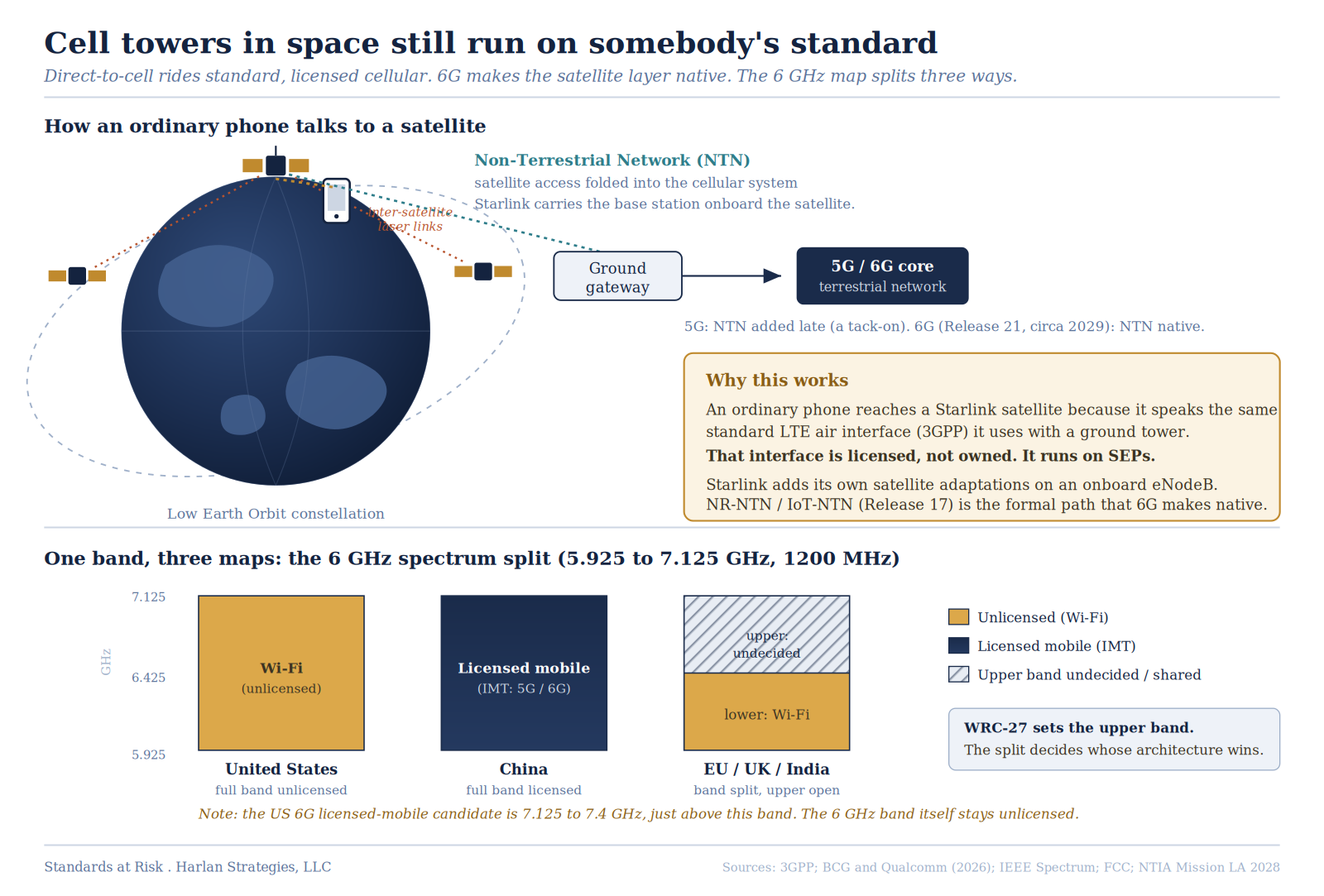
A standard handset reaches a Starlink satellite because the satellite speaks standard cellular. SpaceX runs conventional Long Term Evolution (”LTE”) base stations in orbit, technology the 3rd Generation Partnership Project (”3GPP”) standardized and that carries declared Standard Essential Patents (”SEPs”), with its own proprietary satellite adaptations on top. The reach rides licensed technology SpaceX did not invent.
Today’s direct-to-cell is Non-Terrestrial Network (”NTN”) bolted onto a terrestrial-first 5G design. 6G integrates the satellite layer from the start. Boston Consulting Group and Qualcomm describe 6G as unifying terrestrial and non-terrestrial layers.
The 6 GHz band (radio spectrum, distinct from the 6G cellular generation) splits three ways. The United States made all 1200 megahertz unlicensed for Wi-Fi, China made all of it licensed mobile, and Europe, the United Kingdom and India split it. The 2027 World Radiocommunication Conference (”WRC-27”) decides the upper band.
AI policy now treats open-source and royalty-free as the default path, and a narrower version has surfaced in standards policy: early proposals to open the specification process to royalty-free and open-source contributions. That lets a rival with a large engineering workforce and a state-coordinated standards strategy build on US-funded research without paying for it. Chinese open-weight models already lead the open-source field.
Upgrade velocity is the edge the takeover-math misses. Software-defined satellites take new 3GPP releases by update, and the five-year orbit refreshes the hardware, so Starlink can roll the network to 6G faster than carriers can swap tower radios. A network that keeps implementing more of the standard carries a growing licensing obligation, not a one-time one.
The National Telecommunications and Information Administration (”NTIA”) runs Mission LA 2028 to demonstrate early 6G at the Summer Olympic Games. The Presidential Memorandum “Winning the 6G Race” names the priority. A 6G strategy that celebrates well-funded implementers while casting contributors as the antitrust problem works against its own goal.
What the market saw
The Starlink mobile story comes in two versions. Wall Street prices a takeover. On 26 June 2026, TheStreet relayed a TD Cowen note from analyst Gregory Williams: if rivals keep blocking SpaceX from leasing capacity through a Mobile Virtual Network Operator (”MVNO”) deal, SpaceX could buy T-Mobile outright, a company carrying a market value near $250 billion. Oppenheimer told clients SpaceX could disrupt the $1.6 trillion US communications industry. The feeds carry the other: infographics for “Starlink Mobile, the first hybrid terrestrial-satellite network,” promising one device, one network, everywhere. (link)
The Federal Communications Commission (”FCC”) approved SpaceX’s purchase of EchoStar spectrum in 2026, roughly 65 megahertz (“MHz”) around 2 gigahertz (“GHz”)(the AWS-3, AWS-4 and H-Block bands) for about $19.6 billion, with a technology-neutral waiver to use it across terrestrial, satellite and hybrid networks. SpaceX counts more than 10 million Starlink subscribers. Verizon, AT&T and T-Mobile pooled spectrum in a satellite-to-phone venture in May 2026, read across the trade press as an effort to slow Starlink.
Both versions treat the same two assets as the barrier to entry: the spectrum and the constellation. Neither asks who licenses the technology that makes a hybrid network work. The hybrid is not new, and it is not SpaceX’s. It is what 3GPP standardized as Non-Terrestrial Network. The question both skip is how an unmodified iPhone reaches a satellite in the first place.
The answer is a standard, and the standard is licensed
SpaceX describes its newest satellites as “cell towers in space” that link ordinary smartphones with no special hardware. The phone connects because the satellite speaks standard LTE, the same 3GPP air interface the phone runs with a ground tower, and that interface carries thousands of declared SEPs. Starlink reached the market by putting conventional LTE base stations on its satellites with proprietary adaptations for the satellite link, ahead of and outside the 3GPP Release 17 satellite profiles (the New Radio and Internet of Things NTN profiles, frozen in 2022) that the broader industry and 6G are converging on. The licensed layer is the air interface to the handset. The satellite-side adaptation is SpaceX’s own. An unmodified phone reaches the satellite only because Starlink speaks a standard the phone already implements.
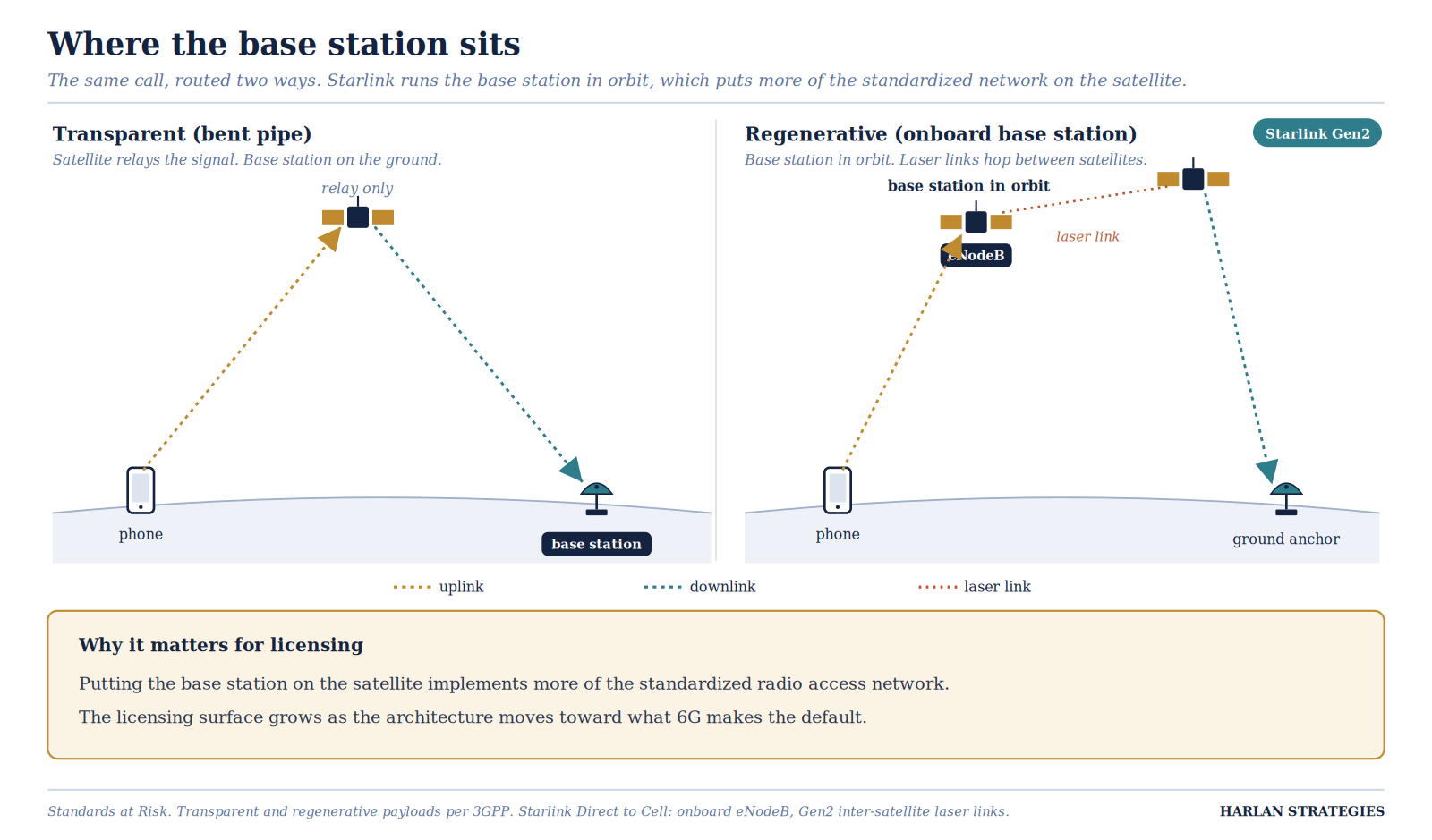
The routing runs in two standardized modes. In the transparent mode the satellite relays the signal to a ground gateway, and the base station sits on the ground. In the regenerative mode the base station runs onboard the satellite, which decodes traffic in orbit and can pass it between satellites over laser links before it reaches a ground anchor. A 2025 crowdsourced-measurement study found Starlink uses the regenerative path. Its Direct to Cell satellites carry an onboard eNodeB, a base station in orbit, and the Gen2 fleet uses inter-satellite laser links so traffic need not always route through a ground station in view. That cuts against the disruption framing. Putting the base station on the satellite implements more of the standardized radio access network, so the licensing surface grows as the architecture advances toward what 6G makes the default.
The competitive threat is real and the standards point does not soften it. SpaceX can undercut carrier pricing, and it can buy a carrier if it wants the dense urban capacity that satellites handle poorly. Grant all of it. None of it changes who created the interoperability. Engineers across the contributing firms built the air interface that lets a phone in a dead zone find a satellite, and they hold patents on it. Capital buys spectrum and launch vehicles. It does not buy the standard, and the standard is licensed. Even the spectrum is standards-bound. SpaceX is aligning the EchoStar bands to 3GPP band designations such as Band n70, already supported in handsets, so ordinary phones recognize them. Spectrum that maps to no standardized band the handsets implement is inert.
That makes SpaceX an implementer, and only an implementer. It contributes nothing to the cellular standards and declares no SEPs, so it carries no licensing commitment of its own. The firms that built the standard hold those obligations. SpaceX’s duty runs the other way, to take a license from them. Musk calls patents “for the weak” and says they mostly block rivals rather than advance anything, and SpaceX patents almost nothing. SpaceX can pay. The open question is whether it will license in good faith, on Fair, Reasonable and Non-Discriminatory (”FRAND”) terms, for technology it did not invent.
6G makes the satellite layer native, not a bolt-on
Release 17 added NTN late, and Releases 18 and 19 extended it onto a design built for towers first. 3GPP’s Release 21, the first 6G release, runs to a functional freeze in 2027 and a final code freeze in 2029. Boston Consulting Group and Qualcomm, in their February 2026 report, describe 6G as a layered architecture that unifies terrestrial and non-terrestrial layers, with satellites complementing higher-band access for global reach. The same report estimates that 5G has already delivered over $1 trillion in global economic impact, projects approximately $6.1 trillion by 2030 and approximately $18.2 trillion by 2035, and dates 6G to precommercial launch in 2028 and commercial launch in 2029. (link)
5G NTN (today) 6G NTN (coming) Origin Added in Release 17 (2022) Designed in from Release 21 Architecture Satellite bolted onto a terrestrial-first system Terrestrial and non-terrestrial unified Service in market Messaging and low-rate data Integrated broadband and sensing (target) Licensing surface NTN SEPs emerging NTN and Direct-to-Device SEPs central
The trajectory runs toward convergence, not toward satellites replacing cellular. A converged network leans on licensed SEPs harder, and brings more vendors onto a common standard. The satellite layer that looks proprietary in 2026 becomes a standardized layer of the 6G system by the end of the decade.
Upgrade velocity is the edge the takeover math misses
The fourth-carrier framing measures Starlink against the incumbents on their own terms: towers, spectrum, subscribers, the price of buying T-Mobile. The larger move is how fast Starlink can roll the network forward. The onboard base stations are software-defined, so the deployed fleet can take new 3GPP releases and features through updates, within the limits of what the radio hardware supports. Low Earth orbit satellites last about five years, so SpaceX refreshes the hardware continuously through replenishment launches rather than on a slow tower-swap cycle. A carrier upgrading to 6G replaces radios across hundreds of thousands of cell sites. Starlink pushes code to the constellation and replaces the constellation every five years. That integrated, proprietary model is the opposite of the industry’s Open Radio Access Network (”Open RAN”) bet, which wagered that open interfaces and disaggregated software would loosen the integrated vendors' grip and instead reconcentrated on them, with Huawei, Ericsson and Nokia holding about three-quarters of the market by Omdia's 2024 count. The genuine disruptor won with integration and a licensed standard, not open software.
The limits are real, and the honest version of the claim respects them. Satellites cannot match terrestrial capacity and density in cities, where most revenue sits, and spectrum authorization runs country by country. “Supplant the carriers” overstates the dense-urban case. The defensible claim is that Starlink becomes the global coverage and roaming layer, competes hard in rural, maritime, aviation and vehicle markets, and pressures carrier economics from the edge inward, while dense urban capacity stays terrestrial for now.
Upgrade velocity points one direction for licensing. A software-defined, continuously replenished network implements a widening set of standardized features across its life and across generations. The relationship with the standard is ongoing, not a one-time hardware purchase, and it expands every time the fleet adopts a new release. That sharpens the willing-licensee question for an operator whose marginal cost of adding standardized capability is a software push. The cheaper it is to implement more of the standard, the stronger the incentive to under-declare what you owe for it.
The spectrum map undercuts “true global coverage”
The 6 GHz band runs 1200 MHz, from 5.925 to 7.125 GHz. The FCC opened the entire band for unlicensed use in 2020, the foundation of Wi-Fi 6E and Wi-Fi 7. China reserved the entire band for licensed International Mobile Telecommunications (”IMT”) in 2023, for 5G and 6G. Europe, the United Kingdom and India released the lower portion for Wi-Fi and left the upper portion open. WRC-27 will decide the upper band.
Keep two spectrum stories apart. The 65 MHz Starlink bought from EchoStar sits around 2 GHz, a low-mid-band layer prized for coverage and indoor reach and already mapped to 3GPP handset bands. The 6 GHz and 7 GHz contest is a separate, higher-band fight over 6G capacity. Starlink’s near-term service rides the first. The 6G race turns on the second.
The US bet has paid off for Wi-Fi. Unlicensed 6 GHz carries large consumer and enterprise value, and that case stands on its own. The US has also entrenched it. In January 2026 the FCC expanded unlicensed 6 GHz use further, and the Winning the 6G Race memorandum signals no appetite to reallocate any of the band. The cost shows up elsewhere. China harmonized 1200 MHz of mid-band for licensed mobile and moved first on the upper 6 GHz for IMT. The US kept all 1200 MHz of 6 GHz unlicensed and is pursuing its 6G licensed spectrum in the adjacent 7 GHz band (7.125 to 7.4 GHz) and other mid-bands, which leaves US operators without the harmonized 6 GHz footprint China is building on. IEEE Spectrum frames the result as the three largest economic blocs drifting toward incompatible spectrum models. “Seamless global coverage” runs into national spectrum rights and diverging band plans. The contest over the upper band is a contest over whose wireless architecture the rest of the world adopts.
What this means for 2028
NTIA launched Mission LA 2028 to stage industry-led demonstrations of early 6G at the Summer Olympics, and received signed letters of intent from interested entities. (link) T-Mobile, the Games’ official telecommunications provider, will run 5G-Advanced with network slicing and satellite coverage across more than 100 venues. The Presidential Memorandum “Winning the 6G Race” names mid-band spectrum as the priority and directs NTIA to study additional bands, including portions of 7.125 to 7.4 GHz. (link) WRC-27 and the 2028 Games sit as checkpoints on the path to 6G standards in 2029.
A second pressure runs alongside the licensing question. The America’s AI Action Plan promotes open source as a path to innovation, and ETSI has begun examining how to make its specification process more amenable to royalty-free and open-source contributions. (link) Open source builds real value, and the case for it in many settings is strong. The strategic cost lands when it becomes the default. A US firm that spends billions to develop a model or a standardized technology, then releases it royalty-free, hands the result to a rival that did not fund it. China runs that play at scale. Chinese open-weight AI models now lead the open-source field. Alibaba’s Qwen overtook Meta’s Llama in October 2025 as the most-downloaded open model family on Hugging Face, and by May 2026 eleven of the twenty most-downloaded text-generation models on the platform were Qwen variants, against three from Llama. (link) A majority of the tokens routed through OpenRouter, a large neutral model router, now run on Chinese-built models. China pairs that engineering output with China Standards 2035, a State Council strategy that coordinates standards work in 5G, artificial intelligence and other critical technologies and pushes Chinese participation in the international bodies. (link) Privileging royalty-free models in the name of transparency or competition would weaken the business-model competition that pays for the next generation of standardized R&D, which is the same R&D the 6G race depends on.
The demonstrations are real and the ambition is correct. The risk is internal. A 6G strategy cannot run on capital and spectrum alone. It runs on the standardized R&D that contributors fund and license, and that funding depends on enforceable SEP rights. The Department of Justice’s recent statements of interest, which protect SEP holders’ ability to license and enforce, point the right way. A return to the posture that treated SEP holders as the competition problem would defund the pipeline the Olympics are meant to showcase. Two priorities follow for policymakers heading into 2028: protect the licensing and enforcement architecture that pays for standardized innovation, and close the mid-band spectrum gap before WRC-27 hardens the divide.
The disruption story will keep running, because a rocket company entering wireless is a good story. Whoever sets the standard and the spectrum map writes the licensing rules that SpaceX and the carriers will both operate inside. That is where the outcome is decided, and it draws far less coverage than the takeover math.
Harlan Strategies, LLC advises licensors and innovators on SEP portfolio strategy and FRAND policy, and publishes the Standards at Risk review. For a discussion of how these developments bear on a specific portfolio or policy position, contact jim@thestandardstrategy.com.
Sources
- Boston Consulting Group and Qualcomm, 6G: The Network for the Future of AI and Immersive Connectivity, Boston Consulting Group, 4, 11, 19 (2026).
- 3GPP, Solutions for NR to Support Non-Terrestrial Networks, Technical Report 38.821, Release 17 (2022).
- 3GPP, Release 21 Work Plan and Timeline, Radio Access Network plenary (2026).
- IEEE Spectrum, 6G and Wi-Fi in a Tug-of-War Over the 6 GHz Band (2026); Federal Communications Commission, Report and Order on unlicensed use of the 6 GHz band (2020), and Fourth Report and Order, ET Docket No. 18-295, FCC 26-1 (2026), expanding unlicensed 6 GHz operations; China Ministry of Industry and Information Technology, allocation of 6 GHz for IMT (2023).
- NTIA, Mission LA 2028 Letters of Intent (2026); The White House, *Winning the 6G Race*, Presidential Memorandum.
- Reuters, reporting on Financial Times coverage of SpaceX Starlink mobile service and the EchoStar spectrum acquisition (2026); TD Cowen (G. Williams) and Oppenheimer analyst notes.
- The White House, Winning the AI Race: America’s AI Action Plan (2025); ETSI IPR Special Committee, work on the treatment of open-source and royalty-free contributions (2026).
- On the Chinese open-weight lead: Xinhua and Alibaba Qwen team announcements (January 2026); Hugging Face Hub API snapshot, 14 May 2026 (eleven of the top twenty text-generation models are Qwen variants, roughly 100 million combined downloads, against roughly 20 million for the Llama models); OpenRouter token-routing analysis showing a majority, approximately 61 percent, on Chinese-built models (2026).
- Central Committee of the Communist Party of China and the State Council, National Standardization Development Outline (2021), and the National Standardization Development Action Plans (2022, 2024), the operative documents of the China Standards 2035 strategy.
- Federal Communications Commission, approval of the EchoStar to SpaceX spectrum assignments (AWS-3, AWS-4 and H-Block), with technology-neutral and buildout waivers (2026); on band alignment, analysis of SpaceX’s mapping of the EchoStar holdings to 3GPP band designations including Band n70.
- On Starlink’s approach and architecture: the constellation runs conventional LTE base stations with proprietary adaptations for the satellite link, a non-3GPP-NTN-compliant design rather than the Release 17 NR-NTN profiles, per a crowdsourced-measurement study of Starlink Direct to Cell (arXiv, 2025); on transparent (bent-pipe) versus regenerative payloads under 3GPP, the onboard eNodeB and Gen2 inter-satellite laser links, and the roughly five-year operational life of low Earth orbit satellites with continuous fleet replenishment.
- Musk, remarks on Jay Leno’s Garage (CNBC, 2022), calling patents “for the weak” and a blocking technique; and Wired (2012), on SpaceX’s decision not to patent given Chinese competition.
- On Open RAN concentration: Omdia data showing the combined RAN market share of Huawei, Ericsson and Nokia rising to roughly 77.5 percent in 2024, and Dell’Oro analysis (S. Pongratz) finding supplier diversity fading across most regions; AT&T’s $14 billion Ericsson agreement as an effectively single-vendor deployment; Dish/EchoStar and Rakuten greenfield losses; industry reporting through Mobile World Congress 2026.