
InterDigital v Amazon, Part 4: What the 10-Q Changes
For the first time, this analysis is anchored to an SEC-filed primary source document. Here is what changes when you replace a single news article with InterDigital’s own verified litigation record.

TL;DR
What this is: Part 4 of a series using a ten-agent AI reasoning system to predict the outcome of the InterDigital v Amazon video codec and streaming patent dispute. This run uses InterDigital’s Q1 2026 10-Q filed April 30, 2026 as the primary seed document -- the first time an SEC-filed primary source has anchored the analysis.
The prediction: A bilateral global patent license agreement in Q3 or Q4 2026, before the UK High Court issues a formal binding RAND judgment. Confidence: 61 percent.
The key driver: The May 28, 2026 UPC Court of Appeal hearing on the Anti-Interim-License Injunction (“AILI”) scope. Whatever it decides accelerates resolution. An upheld AILI compels Amazon to settle to avoid cascading injunction exposure during the Q4 holiday cycle. A narrowed AILI removes InterDigital’s most aggressive enforcement tool and increases its own incentive to settle before losing further ground.
What the 10-Q changed:
The Samsung $1.05 billion ICC arbitration award is the most important new fact. It covers cellular SEP patents in the smartphone context, not video codec patents in the streaming device context, so it is not a directly applicable rate comparable for the Amazon proceedings. What it does signal is the scale of awards InterDigital is willing to pursue through arbitration and its demonstrated willingness to litigate rather than settle early. Samsung challenged the award in December 2025. If the challenge succeeds before September 2026, InterDigital’s internal settlement posture may soften regardless of the technology category difference.
Dolby escalated from a PTAB IPR to Article III federal court in March 2026, seeking declaratory judgment on five patents also being asserted against Amazon. That is a more immediate validity threat than any prior analysis captured.
German court proceedings against Amazon are scheduled for trial in Q3 and Q4 2026 -- independent of the UPC and running on their own timeline. Prior analysis missed this entirely.
The DOJ filed a Statement of Interest in the Disney Delaware antitrust case in October 2025 -- but contrary to the prior analysis framing, it sided with InterDigital rather than against it. The DOJ steered the dispute away from antitrust law, reducing rather than increasing the regulatory flanking risk to InterDigital.
The AV1 correction: The prior analysis modeled AV1 adoption as a risk to InterDigital’s portfolio. That was wrong. InterDigital holds AV1 patents and is actively asserting them against Amazon. Amazon devices capable of decoding AV1 or VP9 content are named as accused instrumentalities in the Delaware complaint. AV1 adoption expands InterDigital’s enforcement surface, it does not erode it.
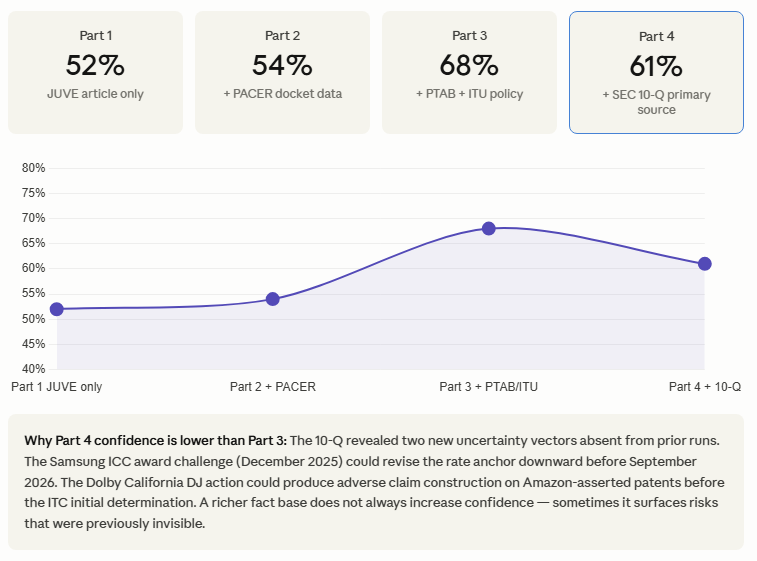
Why confidence dropped from Part 3 (68%) to Part 4 (61%): A richer fact base surfaces previously invisible risks. The Samsung award challenge and the Dolby California proceedings introduce genuine uncertainty that was not in the Part 3 input. It also surfaces corrections -- the AV1 risk framing and the DOJ framing were both wrong in ways that the primary source data revealed. More information does not always increase confidence -- sometimes it reveals what you did not know you did not know.
A Different Kind of Seed Document
Parts 1 through 3 of this series were built from a single JUVE Patent article supplemented by live PACER docket pulls and PTAB API data. Each part improved on the prior one by correcting errors and adding data sources. But all three shared a foundational limitation: the primary seed document was journalism, not primary source material.
Part 4 is different. On April 30, 2026, InterDigital filed its Q1 2026 10-Q with the SEC. The litigation section runs to approximately 22,000 words covering every active proceeding across every jurisdiction against every defendant. It is authoritative, comprehensive, and verified under penalty of law. It covers Amazon, Disney, Dolby, Hisense, TCL, Lenovo, Samsung, Transsion, and Tesla simultaneously.
Running the ten-agent swarm on this document produced the richest output of the series. The confidence number moved to 61 percent. More importantly, three new analytical contributions emerged that were absent from any prior run, and one latent factor surfaced that has received no public attention in the commentary on this dispute.
What the 10-Q Reveals That the Prior Analysis Missed
The Samsung ICC award is a rate anchor with a fuse attached.
In July 2025, an ICC arbitral panel set total royalties of $1.05 billion for an eight-year patent license between InterDigital and Samsung covering Samsung products other than digital televisions and computer display monitors. The award covers cellular SEP patents in the smartphone context -- a different technology layer, different standards body, and different licensing framework from the video codec patents at issue in the Amazon dispute. It is not a directly applicable rate comparable. What it does signal is the scale of awards InterDigital is willing to pursue through arbitration, its demonstrated willingness to litigate to a large outcome rather than settle early, and a data point for board-level settlement authorization thresholds that likely influences how InterDigital calibrates its bilateral demands against Amazon.
The fuse: Samsung filed a request to challenge that award in December 2025. The outcome of that challenge is not externally observable. But if the ICC revises the award downward before September 2026, InterDigital’s internal rate floor weakens, its willingness to hold out for a high bilateral settlement figure diminishes, and the settlement range narrows in Amazon’s favor. This makes InterDigital more risk-averse about the UK trial than its aggressive multi-front posture implies, and that asymmetry is one of the two material changes to the settlement logic in Part 4.
Dolby escalated from PTAB to Article III federal court.
Part 3 identified the Dolby IPR petition against InterDigital US Patent 9,185,268 as a licensor coalition fracture. The 10-Q reveals something more immediate. In March 2026, Dolby filed two declaratory judgment complaints in the Central District of California. The first covers one patent also asserted against Disney. The second covers five patents also being asserted against Amazon, Hisense, and TCL.
Those five patents in Dolby’s Complaint 2 are the same patents being asserted against Amazon. Dolby is not just challenging InterDigital at the PTAB. It is seeking declaratory judgment in federal court on the exact patents at issue in the Amazon ITC investigation and the Eastern District of Virginia proceedings. InterDigital filed a motion to dismiss Complaint 1 in April 2026. The deadline to respond to Complaint 2 has not yet passed.
The analytical implication: if the California court denies InterDigital’s motion to dismiss and the case proceeds, discovery and claim construction in California could produce adverse rulings on the Amazon-asserted patents before the ITC initial determination issues. That would weaken the ITC exclusion order threat that Part 3 identified as the key secondary driver. The Dolby threat is now more immediate and more direct than any prior analysis captured.
The German court proceedings are running on a 2026 trial schedule.
All three prior parts focused on the UPC as the primary European enforcement mechanism. The 10-Q reveals that InterDigital filed three separate infringement proceedings in Munich and Mannheim Regional Courts against Amazon in November and December 2025, and that trials are expected in two of those three proceedings in Q3 and Q4 2026.
German court infringement findings in Q3 or Q4 2026 would arrive before or alongside the September 2026 UK RAND trial. A Munich or Mannheim infringement finding creates injunction pressure on Amazon’s European device sales independent of the UPC AILI proceedings. The prior analysis treated European enforcement pressure as flowing exclusively through the UPC. That was incomplete.
The DOJ filed a Statement of Interest in the Disney Delaware antitrust case -- and it favored InterDigital.
In August 2025, Disney filed an antitrust complaint against InterDigital and Technicolor in Delaware alleging monopolistic conduct in video codec SEP licensing. In October 2025, the Antitrust Division of the United States Department of Justice filed a Statement of Interest in that case.
The prior analysis framed this as regulatory pressure against InterDigital. That framing was incorrect. The DOJ’s Statement of Interest steered the dispute away from antitrust law, consistent with the Trump administration’s broader posture of limiting antitrust scrutiny of SEP licensing disputes. InterDigital filed a motion to dismiss Disney’s antitrust claims. The DOJ’s filing was characterized by observers as tilting toward InterDigital rather than constraining it.
The correct analytical implication is the opposite of what was previously written. DOJ involvement in this posture reduces the regulatory flanking risk to InterDigital in the US rather than increasing it. It signals that the federal government is unlikely to treat InterDigital’s SEP licensing conduct as an antitrust violation, which strengthens InterDigital’s enforcement posture rather than constraining it.
The Revised Pressure Map
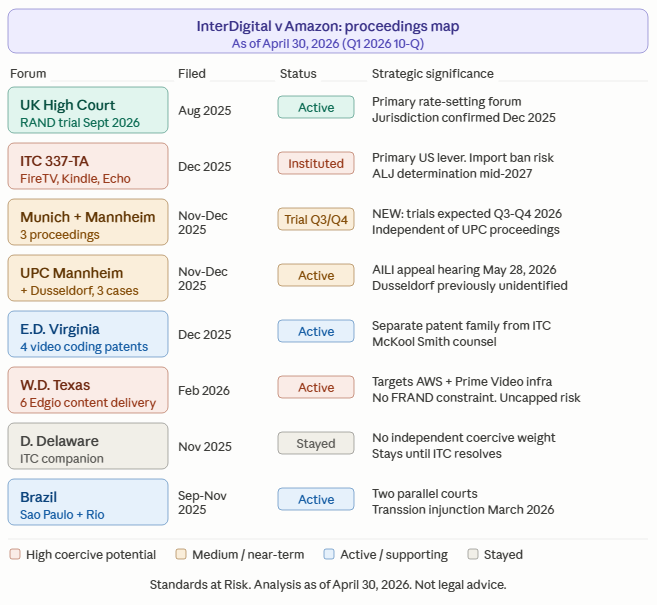
The proceedings map has changed significantly from Part 1. Here is the complete picture as of April 30, 2026:
Against Amazon:
The UK High Court proceedings are active, with jurisdiction confirmed in December 2025 and a RAND trial scheduled for September 2026. The ITC investigation (337-TA filed December 2025) has been formally instituted. The Delaware companion case is stayed pending ITC resolution. The Eastern District of Virginia case (four video coding patents, filed December 2025) is active. The Western District of Texas case (six Edgio-acquired content delivery patents, filed February 2026) is active and targets Amazon’s cloud infrastructure rather than its devices. Three separate German court proceedings are expected to reach trial in Q3 and Q4 2026. Three separate UPC proceedings are active across Mannheim and Dusseldorf Local Divisions.
Against other defendants:
InterDigital obtained a preliminary injunction against Transsion in Brazil in March 2026, enjoining Transsion from selling 5G-compliant devices. The Disney UPC proceedings have hearings scheduled in June and July 2026 in Dusseldorf, which will produce infringement findings before the September 2026 Amazon UK trial. Munich imposed fines of 550,000 euros on Disney in January 2026 for violations of an injunction. The Hisense and TCL Munich proceedings have hearings scheduled for January 2027.
The Lenovo arbitration adds a second ongoing rate proceeding.
InterDigital and Lenovo agreed to binding ICC arbitration in Q4 2024 to determine the final terms of a new patent license effective from January 1, 2024. The ICC confirmed the full tribunal in March 2025. The arbitration hearing is expected before year end 2026. Like the Samsung award, the Lenovo arbitration primarily covers cellular SEP patents rather than video codec patents, so it is not a direct rate comparable for the Amazon proceedings. Its significance is the timing: an ICC arbitration outcome expected before year end 2026 creates a second contemporaneous licensing data point that may influence how InterDigital’s internal rate expectations are set and how its litigation posture is calibrated heading into the September 2026 UK trial.
The AV1 Dimension: Not a Threat to InterDigital, an Expansion of Its Arsenal
The Part 4 swarm surfaced AV1 as a latent factor, modeling it as a risk to InterDigital’s portfolio on the assumption that AV1 is royalty-free and gaining streaming market share. That framing was wrong and the article previously published it incorrectly. The correction matters.
InterDigital holds AV1 patents and is actively asserting them against Amazon. The Delaware complaint defines “AV1/VP9 Accused Instrumentalities” as all Amazon devices capable of decoding AV1 or VP9 content, including Fire Stick 4K, Fire TV Stick 4K Max, Fire TV Cube, Fire Max 11, Echo Show 15, and Echo Show 21. US district court lawsuits over AV1 reached an all-time high in 2025, with InterDigital among the companies driving that increase.
The correct analytical framing is the opposite of what was previously written. AV1 adoption by Amazon devices does not depreciate InterDigital’s enforcement position -- it expands it. Every Amazon device that implements AV1 decoding becomes an additional accused instrumentality. The “royalty-free” characterization of AV1 reflects the Alliance for Open Media’s aspiration for the codec, not a legal determination that no patents cover its implementation. InterDigital and others have asserted that their patents are fundamental to AV1 implementation regardless of the consortium’s royalty-free design intent.
Amazon is a founding member of the Alliance for Open Media, the consortium that developed AV1. The irony is that Amazon’s own investment in developing an allegedly royalty-free alternative to HEVC has not insulated it from patent assertions on that very codec. If anything, AV1 adoption increases the scope of the dispute rather than constraining it.
This correction removes the AV1 adoption risk as a settlement pressure variable on InterDigital. It replaces it with the opposite: AV1 as an additional enforcement layer that expands Amazon’s total exposure beyond the HEVC/HDR patents originally identified.
The Revised House View
Prediction: Amazon and InterDigital conclude a bilateral global patent license agreement in Q3 or Q4 2026, before the UK High Court issues a formal binding RAND judgment. The settlement is structured as a per-unit running royalty on FRAND-committed video coding patents (HEVC/AVC/VVC) with a lump-sum back-payment, plus a separate commercial arrangement for non-FRAND-committed patents including the Edgio-acquired content delivery portfolio, which carries no RAND constraint and therefore gives InterDigital uncapped leverage on that technology layer. The ITC investigation and UPC proceedings are withdrawn or stayed by consent. The UK proceedings are stayed rather than dismissed, preserving the rate-anchoring function without producing a binding precedential judgment.
Alternative Outcome: The UK High Court issues a binding global RAND rate determination in September or October 2026. This occurs if the UPC Court of Appeal narrows the AILI on May 28, 2026, reducing Amazon’s injunction exposure sufficiently that it rationally holds out for a court-determined rate; the ITC timeline slips into 2027, removing peak-demand import ban pressure; and the Samsung ICC award is revised downward on challenge before September 2026, weakening InterDigital’s rate floor and making its bilateral demands appear inflated relative to the emerging comparable license landscape. Amazon accepts the court-determined rate as the license basis within 60 to 90 days of judgment. The Edgio content delivery patents remain in active litigation in Texas as a separate track. Probability: approximately 30 to 35 percent.
Key Driver: The outcome of the May 28, 2026 UPC Court of Appeal hearing on the AILI scope, in combination with the ITC initial determination timeline. These two events, both resolving before the September 2026 UK trial, jointly determine whether Amazon’s multi-jurisdictional injunction exposure is severe enough during the Q4 2026 holiday cycle to compel pre-judgment settlement, or whether Amazon retains sufficient optionality to hold out for the court-determined rate.
Secondary Driver: The Samsung ICC award challenge. The award covers cellular SEP patents rather than video codec patents and is not a direct rate comparable for the Amazon proceedings. But if the challenge succeeds and the award is revised downward before September 2026, it may affect InterDigital’s internal settlement posture and its board-level authorization threshold for bilateral deals -- signaling reduced willingness to hold out for large litigation outcomes across its licensing program generally. This dynamic is entirely invisible in court filings and turns on ICC arbitral proceedings whose timeline and outcome are not externally observable.
Main Uncertainty: Whether the Dolby Complaint 2 California DJ action produces adverse claim construction on the Amazon-asserted patents before the ITC initial determination. If it does, the ITC exclusion order threat weakens materially and Amazon’s calculus shifts toward holding out for the UK judicial rate.
Confidence: 61 percent.
What Changed Across Four Runs
The directional prediction has held across all four iterations: confidential global license, not a public judgment. The mechanism, timing, and confidence have evolved with each run.
Part 1 predicted Q4 2026, driven by the 50 million euro UPC penalty. Confidence: 52 percent.
Part 2 corrected the Delaware error, added the full US docket picture, and moved the window to late 2026 or early Q1 2027. Confidence: 54 percent.
Part 3 added the validity challenge layer, the regulatory flank, and the ITU Common Patent Policy analysis. The window sharpened to July or August 2026. Confidence: 68 percent.
Part 4, anchored to the SEC-filed 10-Q, adds the Samsung ICC rate proceeding, the Dolby California DJ action, the German court trial schedule, the corrected DOJ framing (which favors InterDigital rather than constraining it), and the AV1 correction (InterDigital asserts AV1 patents against Amazon rather than facing AV1 as a portfolio risk). The window widened slightly to Q3 or Q4 2026 to reflect the additional complexity of the pressure map. Confidence settled at 61 percent, reflecting both the richer fact base and the genuine uncertainty introduced by the Samsung award challenge and the Dolby proceedings.
The most important insight across the entire series remains the Adversarial Critic’s contribution from Part 3: InterDigital’s private projection of the UK RAND rate is the unobservable variable that could override the convergence logic regardless of what the courts do. The 10-Q does not resolve that uncertainty. It adds the Samsung ICC award as a signal of InterDigital’s willingness to litigate to large outcomes -- while correctly noting it covers cellular SEP patents rather than video codec patents and is not a direct rate comparable -- and it adds the ICC challenge as a mechanism that could soften InterDigital’s litigation posture if the award is revised downward.
A Note on Methodology
Part 4 introduces one new data source: the InterDigital Q1 2026 10-Q litigation section, obtained from the SEC EDGAR database and processed as the primary seed document. No external API calls were required for this run. The 10-Q text was read directly.
The total input file for Part 4 was 54,808 characters, the largest of the series. A 5-second rate limiting delay was added between API calls to manage the larger token volume per request. The full pipeline, 57 API calls across ten agents, five rounds, coverage audit, and final refinement, cost approximately $4.00 at current Claude Sonnet 4.6 pricing. Runtime was approximately 20 minutes.
The full Python implementation including the 10-Q pre-processor is available at github.com/theharlans/standards-at-risk.
Sources: InterDigital Inc. Form 10-Q for the quarterly period ended March 31, 2026, filed April 30, 2026 (SEC EDGAR). JUVE Patent, “InterDigital vs Amazon: A chronology of the escalation,” March 16, 2026. CourtListener/PACER docket data retrieved April 2026. All analysis is the author’s own. This is not legal advice.