

TL;DR
What happened May 12, 2026: The UK Court of Appeal issued its judgment in Acer and Asus v Nokia Technologies OY, [2026] EWCA Civ 564 (link). Nokia’s arbitration offer was held to constitute a valid FRAND offer under the ITU Common Patent Policy. The Acer and Asus proceedings were permanently stayed. The planned FRAND trial will not proceed. Lord Justice Arnold, who authored the lead judgment, was on the panel.
Why it matters for InterDigital v Amazon: InterDigital is represented by Bird and Bird LLP in the Amazon dispute. The same Bird and Bird partner, Richard Vary, represents Nokia. The arbitration playbook is now legally validated and immediately available.
This dispute is not what it looks like. Amazon already holds a device-level license from InterDigital. InterDigital’s own Q4 2024 investor materials confirm “Amazon licensed for WLAN” in the CE and IoT channel. The ITC complaint targeting FireTV, Kindle, and Echo Show is the enforcement lever -- the mechanism to bring Amazon to the streaming licensing table. The eventual resolution will be a streaming services license under InterDigital’s Video Services licensing program, not a device license. This is InterDigital’s opening move in a $485 billion addressable market that is currently at zero ARR in its 2030 roadmap.
The prediction: InterDigital and Amazon announce binding ICC arbitration to determine the final terms of a streaming services license in Q3 or Q4 2026. The announcement itself is the resolution event -- exactly as the Samsung January 2023 and Lenovo Q4 2024 announcements were. InterDigital begins conservative revenue recognition immediately. All active litigation is stayed by consent. The arbitral tribunal determines the final streaming services rate 18 to 24 months later on a confidential basis. No public FRAND rate enters the record.
The confidence: 60 percent in Q3-Q4 2026 for the arbitration announcement. This is the correct endpoint -- not Amazon accepting a final streaming license, but Amazon agreeing to have a neutral ICC tribunal determine whether and on what terms streaming services require a separate patent license.
The key driver: The May 28, 2026 UPC Court of Appeal hearing on the AILI penalty orders. The critical question is whether any modified AILI retains enough coercive force -- in penalty quantum and geographic scope -- to override Amazon’s internal resistance. A modified AILI that preserves the core 50 million euro penalty structure tips toward settlement. A modified AILI that reduces the penalty cap below approximately 20 million euros or narrows geographic scope to exclude major EU markets likely tips toward the UK trial proceeding.
The threshold question that has not been connected to the Nokia EWCA arbitration analysis: Before the Nokia EWCA framework applies, someone must determine whether any asserted patents are ITU-T declared SEPs. Based on patent-level analysis, the identified portfolio reads primarily on AV1 and HDR -- not HEVC decoder-side SEPs. AV1 was developed by the Alliance for Open Media, not an SDO. The ITU Common Patent Policy was never declared on AV1 patents. And even for patents that might qualify, “would be required to implement” under the ITU policy is governed by Swiss law and undefined -- to the best of my knowledge courts have not determined whether it means technically required or commercially required. The encoding/decoding essentiality question is formally in dispute before Judge Meade, with the WilmerHale FRAND Quarterly noting in March 2026 that the Amazon proceedings center on “whether the ITU-T RAND obligation applies to both encoding and decoding patents or only the latter.” (link)
The methodology: Part 5 ran six separate swarm iterations. Confidence across the six runs: 63, 54, 61, 64, 47, and 60 percent. The volatility is itself an analytical signal -- the confidence number is sensitive to how you frame the endpoint. The definitive run uses the correct two-layer framework: Layer 1 is the arbitration announcement (the prediction endpoint), Layer 2 is the final arbitral award 18 to 24 months later.
What the Nokia EWCA Decision Actually Holds
The judgment in Acer v Nokia is more nuanced than the headline framing suggests.
Nokia owns a portfolio of SEPs declared essential to ITU-T H.264/AVC and H.265/HEVC video decoding standards. Acer and Asus filed in the UK Patents Court seeking a court-determined global FRAND rate. Nokia challenged jurisdiction and offered arbitration instead. Justice Mellor at first instance rejected Nokia’s position and granted interim license declarations. Nokia appealed.
The Court of Appeal reversed. Three holdings matter for the Amazon dispute.
Nokia’s arbitration offer constitutes a valid FRAND offer capable of acceptance. An implementer who refuses a genuine arbitration offer and insists on court-determined terms is not a willing licensee in the relevant sense.
The ITU Common Patent Policy does not require a SEP holder to submit to court jurisdiction. The FRAND commitment is a commitment to license on reasonable terms -- not a commitment to have those terms set by a national court.
The stay is conditioned on Nokia agreeing that statements of case, disclosed documents, and evidence from the English proceedings stand as arbitration materials, and that costs incurred are costs in the arbitration.
The Wolters Kluwer Patent Blog (link) correctly identified the deeper doctrinal point the day after the judgment: the Court of Appeal did not compel arbitration. It recognized that Nokia’s offer embedded arbitration within the performance of a contractual undertaking. The FRAND obligation is a contractual obligation to make access available on objective terms. Arbitration does not displace it -- it may concretize it.
Nokia also offered an immediate interim license alongside the arbitration offer. The Court expressly left open whether a mere offer to arbitrate, without an accompanying interim license, would suffice. InterDigital therefore needs to include an immediate interim license in its offer to Amazon to maintain the full protection of the Nokia precedent.
What Arnold LJ expressly left open:
Whether the Adjustable License’s litigation abandonment term -- requiring parties to stay or abandon their own litigation as a condition of the license -- could be used to distinguish a future offer was left open at paragraphs 28 and 92. Whether an implementer with a legitimate and substantiated objection to the proposed arbitral mechanism could resist the stay was also left open. Amazon holds patents and has active UK and Brazilian proceedings. These are its primary avenues of resistance.
The Threshold Question: Are These Patents Even SEPs?
Before the Nokia EWCA arbitration framework applies to the Amazon dispute, a threshold question must be resolved that has not yet been connected to this decision in public commentary.
The AV1 FRAND gap has been noted. IP Fray observed in February 2026 (link) that “InterDigital definitely didn’t participate in VP9 and AV1 standard-setting, so there are no FRAND pledges in place with respect to those standards.” The WilmerHale FRAND Quarterly noted in March 2026 that the Amazon UK proceedings center on “whether the ITU-T RAND obligation applies to both encoding and decoding patents or only the latter” -- confirming the essentiality question is formally in dispute before Judge Meade.
What has not been connected to the Nokia EWCA decision is the consequence: if the asserted patents are not ITU-T declared SEPs, the procedural trap created by Acer v Nokia may not close on Amazon at all. The unwillingness finding flows from refusing a valid FRAND offer. If the patents are not FRAND-encumbered, there is no valid FRAND offer to refuse.
Based on patent-level analysis of the identified US proceedings:
The ITC and Delaware companion patents (US 10,741,211, US 9,747,674, US 8,363,724, US 8,681,855, and US 11,917,146) read primarily on AV1 and HDR, not on HEVC decoder-side implementations. AV1 was developed by the Alliance for Open Media -- not by ITU-T. No ITU Common Patent Policy declaration was made on AV1 patents. InterDigital joined the SISVEL AV1/VP9 pool in March 2020 but is no longer a member, having chosen direct bilateral assertion at rates unconstrained by the SISVEL pool ceiling of approximately 0.11 euros per device.
The Eastern District of Virginia patents (US 8,149,338, US 11,252,435, US 12,149,734, and US 12,143,606) similarly read on AV1 and HDR. The Western District of Texas patents are definitively non-SEP Edgio-acquired content delivery patents -- US 7,921,259, US 10,116,565, US 8,745,128, US 9,015,416, US 8,868,701, and US 8,583,769 -- with no connection to any video codec standard.
US 8,363,724 has additional corroboration: formerly owned by Technicolor, who self-declared it essential to H.265, and previously in the SISVEL pool. InterDigital’s ITC complaint in Investigation 337-TA-3869 alleges each of the five ITC patents is essential to ITU-T H.265 -- that allegation, made in a federal enforcement proceeding, is the primary evidentiary basis for the Category 1 characterization.
InterDigital’s SISVEL pool departure reflects its preference for direct bilateral assertion unconstrained by pool ceilings. Some pools reward active litigators through enhanced distribution mechanisms. The pool departure maximizes direct recovery potential while concentrating validity risk on individual patents. The Unified Patents IPR challenge to US 8,363,724 illustrates that exposure.
The ITU Common Patent Policy essentiality gap:
The ITU policy’s “would be required to implement” threshold is governed by Swiss law and is undefined. ETSI uses “necessary” -- interpreted as technically necessary at the claim level. The ITU policy leaves open whether “required” means technically required or commercially required. Swiss courts and arbitral tribunals have not resolved this, to the best of my knowledge. Non-US courts including UPC Local Divisions and any ICC arbitral tribunal will need to address it independently.
The pro-licensor consequence:
If the AV1 and HDR patents fall outside the FRAND framework, InterDigital can assert them on uncapped commercial terms with no FRAND ceiling. FRAND is Amazon’s preferred battlefield because it potentially caps the rate. If the patents escape FRAND characterization, InterDigital seeks market-rate licensing unconstrained by any SDO declaration.
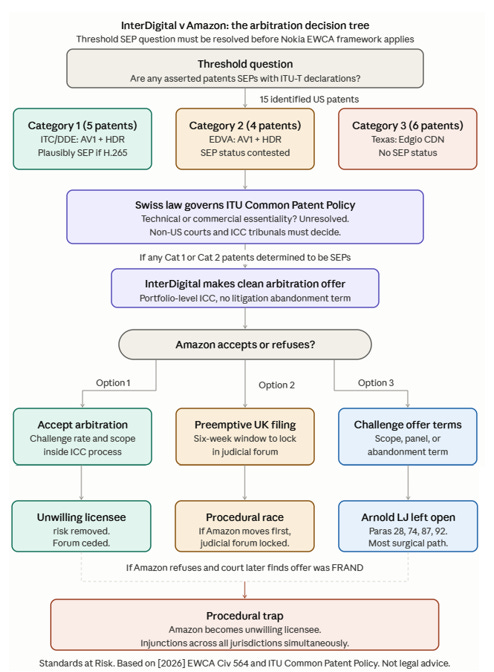
The Arbitration Weapon and Its Catch
InterDigital has a clear playbook. It can offer Amazon portfolio-level ICC arbitration, structured similarly to its Samsung and Lenovo agreements, and apply to the UK High Court for a stay of the FRAND proceedings. Under the May 12 EWCA decision, that application has a strong legal foundation -- provided the offer includes an immediate interim license and avoids the litigation abandonment term Arnold LJ flagged at paragraphs 28 and 92.
Amazon holds patents and has active affirmative proceedings in the UK and Brazil. If InterDigital replicates Nokia’s litigation abandonment term, Amazon has a distinguishing argument. A clean offer -- ICC arbitration, portfolio scope covering all patent categories, no litigation abandonment condition, immediate interim license, neutral seat and panel selection -- would be significantly harder to resist.
The Procedural Trap: Good Faith Refusal and the Unwilling Licensee Risk
The May 12 EWCA decision created a structural asymmetry that Amazon’s legal team will have identified immediately.
InterDigital makes Amazon a clean arbitration offer. Amazon believes in good faith the offer is not FRAND -- perhaps because the scope risks cascading into AWS and Prime Video infrastructure. Amazon refuses. The UK court later finds the offer was a valid FRAND offer. Amazon is retroactively characterized as an unwilling licensee -- not for refusing a license, but for refusing what the court determined was a FRAND offer. Amazon loses willing licensee status without ever getting a merits determination on the rate.
Amazon has three strategic responses.
Accept the arbitration offer and challenge rate, scope, and structural terms within the arbitral process. Unwilling licensee risk removed. Forum ceded to InterDigital. Critically, Amazon is NOT accepting that streaming services require a separate license -- it is agreeing to have a neutral tribunal determine that question. This is a materially lower bar than accepting a final license.
Preemptively file in the UK court for a determination that any InterDigital arbitration offer is not FRAND before the offer is formally made. The six-week procedural race.
Accept the principle of arbitration but challenge the specific structural terms of InterDigital’s offer. Arnold LJ left this open at paragraphs 28, 74, 87, and 92. The most surgical path.
The asymmetry did not exist before the May 12 judgment. It is a genuine shift in InterDigital’s favor regardless of which option Amazon pursues.
The Two-Layer Framework: Announcement as Resolution
The most important analytical refinement in Part 5 is the distinction between two resolution events: the announcement of binding arbitration and the final arbitral award. These occur years apart. For prediction purposes, the announcement is the event that matters.
Layer 1 -- The announcement (the prediction endpoint):
InterDigital and Amazon announce binding ICC arbitration to determine the final terms of a streaming services license. This single announcement stays all active litigation by consent, begins InterDigital conservative revenue recognition immediately, removes the September 2026 UK trial risk for both parties, and gives InterDigital proof of concept for its 2030 ARR roadmap. Amazon is not accepting that streaming services require a separate license -- it is agreeing to have a neutral tribunal determine that question. All of Amazon’s arguments on rate, scope, streaming licensing legitimacy, AWS pass-through liability, and cascade externality cost are preserved for the tribunal.
Samsung precedent: January 1, 2023 announcement. Q1 2023 conservative revenue recognition began. The Q1 2023 10-Q stated: “We believe that it is likely the arbitration award will exceed the conservative estimate and require a true-up at that time.” July 2025: $1.05 billion ICC award, 2.5 years after announcement.
Lenovo precedent: Q4 2024 announcement. Revenue recognition began immediately. Award expected year-end 2026.
Layer 2 -- The arbitral award (18-24 months later):
The ICC tribunal determines the final terms of the streaming services license. Confidential. No public precedent. The tribunal addresses the streaming licensing legitimacy question, the rate methodology for SVOD and AVOD, and the AWS pass-through liability scope -- all on a confidential basis that protects both parties from public precedent.
Why Layer 1 has higher probability than prior runs captured:
Amazon is agreeing to arbitrate -- not to accept InterDigital’s streaming licensing theory. The bar is materially lower than accepting a final license. The Nokia EWCA procedural trap means refusing a properly structured arbitration offer risks the unwilling licensee finding. InterDigital’s institutional investor pressure and ARR target create board-level urgency to announce an arbitration agreement before the Q3 2026 earnings call. And crucially, the AWS pass-through liability uncertainty actually favors Layer 1 -- if Amazon’s legal team concludes AWS pass-through liability is material, announcing arbitration to contain the scope is better than litigating through a public UK judgment that could establish broader liability. Arbitration scope is negotiated and confidential. Judicial scope is public and precedential.
InterDigital’s Strategic Imperative: Streaming
InterDigital’s September 2024 investor day announced a target of $1 billion in annual recurring revenue by 2030 across three channels. Channel 1 -- smartphone -- currently at $491 million ARR, target $500 million. Channel 2 -- consumer electronics, IoT, and automotive -- currently at $97 million ARR, target $200 million. Channel 3 -- streaming and cloud services -- currently at zero ARR, target $300 million or more.
Amazon is the first major enforcement action in Channel 3. No major streaming platform has been licensed under the Video Services program yet. InterDigital’s Q4 2025 earnings call stated: “Litigation against major streaming services is progressing favorably with positive injunctions achieved.”
A resolution that produces no streaming services license at all would signal to every other SVOD and AVOD platform that Prime Video is not licensable. That signal would undermine the entire Channel 3 thesis. InterDigital cannot accept that outcome. Amazon knows this. The negotiation is not about whether there will be a streaming component -- it is about the rate structure, scope, and whether the license is structured to minimize its value as a public reference point for Netflix, Disney Plus, and every other platform.
The Disney precedent is directly relevant. InterDigital filed against Disney as a streaming service in the same Video Services program enforcement campaign. Disney streaming services were injuncted in Brazil and Germany. Munich imposed 550,000 euros in fines on Disney in January 2026 for injunction non-compliance. Disney is the direct comparable for Amazon’s litigation posture and settlement calculus. If Disney announces arbitration before Amazon does, Amazon becomes the last holdout against an established licensing program rather than the industry’s test case defender.
The Three-Category Patent Framework
The portfolio InterDigital is asserting contains three distinct patent categories.
Category 1: Plausibly FRAND-committed SEPs (approximately 5 of 15 identified US patents).
The ITC/Delaware patents. InterDigital’s ITC complaint in Investigation 337-TA-3869 alleges each is essential to ITU-T H.265. US 8,363,724 has additional corroboration from Technicolor’s prior H.265 self-declaration. Amazon cannot cleanly refuse arbitration on the grounds the portfolio is “not FRAND” because these five patents almost certainly carry FRAND obligations.
Category 2: Contested implementation patents with uncertain FRAND status (approximately 4 of 15).
The Eastern District of Virginia patents -- AV1 and HDR. InterDigital’s position is that encoder-side patents are not FRAND-committed because HEVC specifies only decoder behavior. FRAND status legally unresolved.
Category 3: Definitively non-SEP content delivery patents (approximately 6 of 15).
The Western District of Texas Edgio-acquired patents. No connection to any video codec standard. No FRAND obligation. Targets AWS and Prime Video infrastructure. Uncapped damages potential.
The critical clarification: Amazon already holds a device-level license from InterDigital covering WLAN and related device technologies. InterDigital’s Q4 2024 investor materials confirm “Amazon licensed for WLAN.” The ITC complaint targeting FireTV, Kindle, and Echo Show is the enforcement lever -- not the subject of the eventual license. The resolution will be a streaming services license under the Video Services program.
The bundled arbitration path covering all three categories in a single ICC proceeding is more efficient for Amazon than fighting each category separately across three different legal frameworks simultaneously.
The German Enforcement Mechanism and UPC Compliance Failures
The German Regional Court proceedings are a primary business-pressure mechanism and the UPC Mannheim compliance failures are a distinct and compounding enforcement risk.
InterDigital filed three separate infringement proceedings in Munich and Mannheim Regional Courts against Amazon in November and December 2025. Trials are expected in Q3 and Q4 2026.
The UPC Mannheim compliance record is aggressive. February 6, 2026: Mannheim court requested explanations regarding the UK hearing. February 11, 2026: order stating that claims for damages in the UK proceedings could improperly interfere with UPC jurisdiction -- constraining the settlement structure itself. February 27, 2026: Mannheim found Amazon in breach of the ASI and required a formal declaration before the UK High Court. March 9, 2026: Judge Tochtermann questioned whether Amazon’s UK declaration had binding legal effect. Both the German ASI and the UPC AILI were issued ex parte -- Amazon could not pre-empt them with UK applications, increasing exposure to compounding enforcement actions.
Amazon has already demonstrated a ceiling on its litigation tolerance by withdrawing its UK damages claim under UPC coercive pressure. That is not a trivial concession and signals that Amazon’s attrition posture has limits. The sequential enforcement escalation -- breach findings, compliance orders, financial penalties -- creates a live contempt exposure that is not merely theoretical.
Munich imposed 550,000 euros in fines on Disney in January 2026 for injunction non-compliance. That enforcement template makes Amazon’s European exposure more quantifiable and less deferrable than prior analysis assumed.
Amazon’s Structural Resistance and the Streaming Industry Collective Action Dynamic
Amazon’s resistance to any streaming services license is structurally more durable than a simple cost-benefit calculation suggests -- and for a reason the prior analysis missed entirely.
If Amazon accepts a streaming services license, it does not just bear its own royalty burden. It sets an industry-wide MFN-anchored ceiling that harms every SVOD and AVOD competitor simultaneously. Netflix, Apple TV Plus, Disney Plus, and Paramount Plus all compete with Prime Video. Amazon accepting a streaming patent license baseline creates a cost structure that InterDigital can then use as a floor in negotiations with every other streaming platform. Amazon is effectively litigating on behalf of the entire streaming industry, and the industry has a material financial interest in Amazon holding the line.
This streaming industry collective action dynamic -- Netflix, Apple, and other SVOD platforms informally coordinating to support Amazon’s resistance -- is structurally invisible in the public litigation record. But it raises Amazon’s effective settlement floor above what InterDigital’s institutional shareholder pressure requires InterDigital to accept. If this coordination is real and Amazon internalizes the industry-wide precedent cost, the gap between the parties’ reservation prices may be unbridgeable before the September 2026 trial.
The AWS pass-through liability dimension compounds this. AWS CloudFront and Elemental Media Services customers use Amazon’s infrastructure to deliver their own streaming content. If a streaming services license attaches to video delivery infrastructure, the royalty obligation could extend beyond Prime Video to reach AWS customers -- a liability exposure orders of magnitude larger than Prime Video alone. Paradoxically this uncertainty could either accelerate settlement (Amazon wanting to contain scope through confidential arbitration) or harden resistance (any license risks activating the pass-through problem). The direction depends on Amazon’s internal quantification of that exposure.
The DG COMP flank:
InterDigital’s subsidiary DRNC Holdings acquired the six Edgio content delivery patents from Edgio Inc.’s bankruptcy in January 2025 -- seven months before Amazon filed in the UK. The pre-dispute timing, targeting Amazon’s cloud infrastructure specifically, is a potential basis for a complaint to DG COMP under Article 102 TFEU. The UPC Mannheim notified the European Commission on December 24, 2025. A DG COMP complaint does not produce immediate relief but gives Amazon additional leverage in negotiating any arbitration scope.
The Revised House View
Prediction: InterDigital and Amazon announce binding ICC arbitration to determine the final terms of a streaming services license in Q3 or Q4 2026. The announcement is the Layer 1 resolution event -- stays all litigation, begins conservative revenue recognition for InterDigital, removes the September 2026 UK trial risk for both parties. The Layer 2 arbitral award follows 18 to 24 months later on a confidential basis, covering Prime Video delivery as an SVOD and AVOD streaming platform at a rate deliberately structured to minimize its value as a public industry reference point. No public FRAND rate enters the record. The streaming industry collective action dynamic means Amazon accepts arbitration -- not because it concedes the streaming licensing theory -- but because confidential ICC arbitration scope is better than a public judicial determination that could activate the AWS pass-through liability problem.
Alternative Outcome: The September 2026 UK High Court FRAND trial proceeds to a full judgment, issuing a global rate determination in late 2026 or early 2027. This occurs if the UPC Court of Appeal on May 28 vacates or materially narrows the AILI, reducing the penalty cap below the level that makes Amazon’s cost-of-delay calculus favor settlement, and if the Dolby California DJ complaint produces an adverse claim construction on the five Amazon-asserted patents before September 2026, collapsing a material portion of InterDigital’s patent position. The judicially-set rate excludes encoder-side patents and becomes a structurally damaging precedent for InterDigital’s Video Services program. Probability: approximately 30 to 35 percent.
Key Driver: The May 28, 2026 UPC Court of Appeal hearing on the AILI penalty orders. A binary survival or vacatur is less likely than a partial modification. The critical question is whether any modified AILI retains enough coercive force -- in penalty quantum and geographic scope -- to override Amazon’s resistance. A modified AILI preserving the core 50 million euro penalty structure tips toward settlement. A modified AILI reducing the penalty cap below approximately 20 million euros or narrowing geographic scope to exclude major EU markets likely tips toward trial.
Residual Uncertainty: Whether the streaming industry collective action dynamic -- Netflix, Apple, and other SVOD platforms informally coordinating to support Amazon’s resistance -- is sufficiently organized and financially material to raise Amazon’s effective settlement floor above what InterDigital’s institutional shareholder pressure requires InterDigital to accept. This factor is structurally invisible in the public litigation record and cannot be resolved from available information.
Main Disagreement: Whether InterDigital will deploy the Nokia EWCA arbitration stay mechanism as a forcing function for settlement, or withhold it because the UK trial trajectory on encoder-side essentiality produces a judicial rate at or above InterDigital’s arbitration floor, making court-driven resolution preferable. The Adversarial Critic argues the UK trial is more likely to proceed to judgment than the consensus assumes because InterDigital’s incentive to stay the proceedings depends on a private rate calculation no external analyst can observe.
Confidence: 60 percent in Q3-Q4 2026 arbitration announcement.
What Changed Across Five Parts
The directional prediction has held across all five iterations: confidential global resolution, not a public judgment. The mechanism, timing, and confidence have evolved significantly.
Part 1 predicted Q4 2026, driven by the UPC penalty. Confidence: 52 percent.
Part 2 corrected the Delaware error. Confidence: 54 percent.
Part 3 added the validity challenge layer and ITU Common Patent Policy analysis. Confidence: 68 percent.
Part 4 anchored to the Q1 2026 10-Q, added the Samsung ICC award, Dolby California DJ action, and German court trial schedule. Confidence: 61 percent.
Part 5 ran six swarm iterations. The final definitive run incorporates the Nokia EWCA judgment, the Samsung and Lenovo two-layer announcement framework, the patent fraction stress test, InterDigital’s 2030 ARR streaming channel roadmap, the Amazon existing device license correction, and the streaming industry collective action dynamic. Confidence: 60 percent in Q3-Q4 2026 arbitration announcement.
The confidence volatility across Part 5 runs -- 63, 54, 61, 64, 47, 60 -- is itself an analytical signal. The number is sensitive to how you frame the endpoint. A final streaming license has a different probability than a binding arbitration announcement. The Samsung and Lenovo precedents establish that the announcement is the correct endpoint. Under that framing, 60 percent is the honest convergence.
The most important analytical development across the series is the identification of the streaming industry collective action dynamic and the two-layer announcement framework. This dispute is not a device patent enforcement action. It is InterDigital’s opening move in a $485 billion addressable market licensing channel that does not yet exist in its ARR base. The Samsung and Lenovo precedents show how InterDigital wins: not by extracting a final rate, but by announcing that the rate will be determined by a neutral tribunal -- and booking the revenue immediately.
A Note on the Methodology
Part 5 ran six separate swarm iterations before producing the final output published here. Each iteration added new analytical material. The six runs produced confidence levels of 63, 54, 61, 64, 47, and 60 percent. The volatility reflects genuine uncertainty about endpoint definition, not analytical instability. The final run uses the correct two-layer framework anchored to the Samsung and Lenovo arbitration announcement precedents.
The definitive Part 5 input file reached approximately 145,000 characters, the largest of the series. The swarm ran on Claude Sonnet 4.6 via the Anthropic API. The Anthropic API experienced a sustained Sonnet 4.6 capacity incident on May 12, 2026 during North American business hours. All six Part 5 runs completed successfully after the incident resolved.
The full Python implementation including all pre-processors and the ten-agent swarm architecture is available at github.com/theharlans/standards-at-risk.
Sources: [2026] EWCA Civ 564, Acer Incorporated and Asus v Nokia Technologies OY and others, judgment May 12, 2026, judiciary.uk. InterDigital Inc. Form 10-Q for the quarterly period ended March 31, 2026, filed April 30, 2026, SEC EDGAR. InterDigital FY2025 Annual Report, SEC EDGAR. InterDigital Q4 2024 supplemental materials, February 6, 2025, SEC EDGAR. InterDigital Q3 2025 supplemental materials, October 30, 2025, SEC EDGAR. InterDigital press release, “InterDigital and Samsung conclude arbitration and announce new license agreement,” July 29, 2025, ir.interdigital.com. InterDigital Form 10-Q for the quarterly period ended March 31, 2023, SEC EDGAR. Matthieu Dhenne, “Come Together? Acer v Nokia and the Contractual Turn of FRAND Arbitration,” Kluwer Patent Blog, May 13, 2026. WilmerHale FRAND Quarterly, March 2026. IP Fray, February 2026. UK Supreme Court case record UKSC/2025/0058, Tesla v InterDigital and Avanci, heard April 28 to 30, 2026, decision forthcoming. All analysis is the author’s own. This is not legal advice.