
Prepared to Grant
The Clause 6.1 obligation sits at the foundation of FRAND. Optis v Apple will reach the UK Supreme Court without it.

A note on this piece. I applied on 20 April 2026 for permission to file a written-only intervention in Optis Cellular Technology LLC v Apple Retail UK Limited (UKSC/2025/0144 and 0145), directed at one question: how the “prepared to grant” obligation in Clause 6.1 of the ETSI Intellectual Property Rights Policy should be construed under its governing French law, and what follows for the willing-licensor/willing-licensee analysis. No party and no other intervener had raised it. Apple did not consent. The application was refused, without reasons. The appeal will be heard from 29 June to 1 July 2026 without this argument. I am publishing the analysis so it reaches the field.
Disclosure: I was employed by PanOptis during 2014 and 2015, roughly a decade before this appeal and two years before PanOptis first reached out to Apple. That employment is recorded on my public LinkedIn profile. I did not include it in the original intervention application, but following the observation from Apple’s outside counsel, Wilmer Hale, I promptly amended said application.
TL;DR
Courts deciding Fair, Reasonable and Non-Discriminatory (”FRAND”) cases reach for the willing-licensor/willing-licensee construct without first reading the instrument that creates the obligation. That instrument is the ETSI Intellectual Property Rights (”IPR”) Declaration, and it is governed by French law.
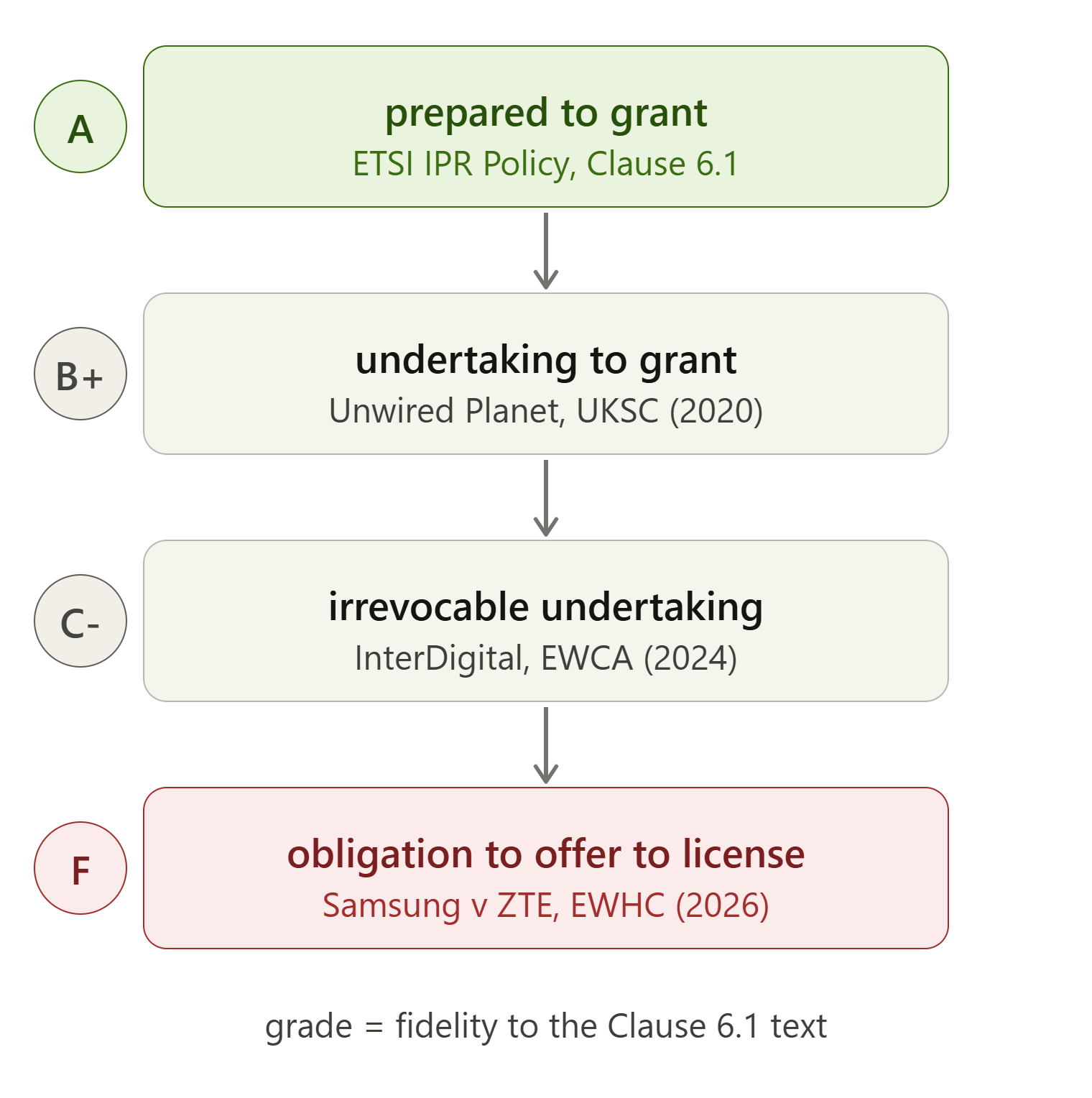
Clause 6.1’s “prepared to grant” is operative language. Under French law the Declaration is an irrevocable unilateral undertaking (engagement unilatéral de volonté). The phrase records a present, continuously maintained state of readiness, backed by years of research, prosecution, and essentiality work. It carries specific legal weight and is not boilerplate.
Readiness runs both ways. The SEP owner’s undertaking does not evaporate, but the equitable and contractual protections the framework extends to an implementer are not unconditional. An implementer shown to be unwilling cannot claim them in full.
For Optis v Apple, that reading bears directly on the comparables methodology behind Grounds 1 and 2, and on the limitation-periods question in Ground 4.
I. What kind of institution ETSI is
This is an analysis of Standard-Essential Patent (”SEP”) licensing and the construction of one obligation, “prepared to grant.” It starts where the case law seldom does: with the institution that produced the technology and the document that records the licensing commitment.
Distinguish Standards Development Organizations (”SDOs”) from Standards-Setting Organizations (”SSOs”). SSOs such as ANSI, BSI, or ISO set standards in the conventional sense, prescribing specifications such as paper dimensions, screw thread pitches, or safety classifications. And SDOs, such as The European Telecommunications Standards Institute (”ETSI”) and the International Telecommunication Union (”ITU”), are a fundamentally different kind of institution. They do not simply codify existing practice. They facilitate an iterative, consensus-based technical development process among a wide range of stakeholders, including network operators, device manufacturers, chipset suppliers, research institutions, and patent holders, whose commercial interests are often in direct and sometimes acute conflict with one another.
The technologies that emerge from this process are not “inserted” by participants with issued patents to promote. They are the product of sustained, contested, multi-party negotiation in which any given technical solution reflects compromise among competing approaches, some of which happen to be covered by patents that participants have declared as potentially essential.
II. Begin with the text, and the law that governs it
Elementary legal method requires that analysis of any contractual obligation begin with the text of the instrument that creates it, construed in accordance with its governing law. For the ETSI IPR Declaration, those requirements point in the same direction, and yet courts routinely bypass them, proceeding directly to policy-level reasoning about the purposes of FRAND without first reading the document that gives rise to the obligation they purport to apply.
ETSI is headquartered in Sophia Antipolis, France. The ETSI IPR Policy, which forms part of the ETSI Rules of Procedure, expressly provides that it is governed by the laws of France. That is not incidental. Under French law, the ETSI IPR Declaration is properly characterized as an irrevocable unilateral undertaking (engagement unilatéral de volonté), by which the declarant binds itself, in advance and without condition, to make licenses available to all implementers on FRAND terms. This is a distinct and well-recognized instrument under French civil law. It creates an obligation on the declarant that is enforceable by third-party beneficiaries, namely implementers, without the need for a bilateral agreement to have been concluded. The consequences of that characterization have profound implications for how the scope and limits of the FRAND obligation should be understood, implications that no court applying English or United States law has engaged with in any systematic way.
The text of the Declaration must be the starting point. The ETSI IPR Declaration form requires the declarant to confirm, in the exact language of Clause 6.1, that it is “prepared to grant irrevocable licences on fair, reasonable and non-discriminatory (’FRAND’) terms and conditions.” (emphasis added) Those three words, “prepared to grant,” are the operative language of the obligation. They are not preamble. They are not a mere statement of intent. On a plain reading they are the legal act the Declaration performs: the declarant represents, as a matter of binding commitment, that it is in a state of readiness to grant a license. That representation has a specific legal character. It is not an offer in the contractual sense. It is not a promise to make an offer in future. It is a present-tense declaration of preparedness that creates an ongoing obligation to remain in that posture.
What courts consistently fail to appreciate is that this state of readiness is neither passive nor costless, and it is not a single event. It is the expression of a substantial, multi-stage technical and legal undertaking that both precedes and continues after the filing of the Declaration, and that gives the “prepared to grant” commitment its substantive content. An ETSI IPR Declaration is not a confirmation of established essentiality. The Policy and the form require the declarant to act on a present good-faith belief: the form states that it is the “declarant’s present belief that the IPR(s) disclosed may be or may become ESSENTIAL” to the relevant standard. That formulation is deliberately prospective. It covers pending patent applications as well as granted patents. It acknowledges that the standard may still be evolving at the time of declaration, and that the relationship between the declared claims and the final standard text is not yet fully determined.
To reach the point of filing, the declarant will have invested in research and development, participated actively in the contested working group process, and identified patent claims it believes are or may become essential to the normative requirements of the emerging standard. The declarant must then map those claims with care against the adopted technical specification, because a claim is only essential if it is impossible to implement the relevant part of the standard without infringing it, with no technical workaround available. That essentiality analysis is itself a demanding exercise of legal and technical judgment, requiring a granular comparison of claim language against mandatory provisions of standards documents that may run to thousands of pages.
The declarant must also prosecute its patent applications through one or more national or regional patent offices. That prosecution is not a formality. It is an interactive, adversarial process in which claims are examined, objections are raised, and amendments are made. It must track the evolution of the standard itself, because the standard may be modified during the examination period, and claims drafted to capture an earlier version of the specification may need revision to maintain their essential character relative to the final adopted text. Amendments required by the patent office may alter the scope of the claims in ways that affect their relationship to the standard. Changes made to the standard during the 3GPP release process may affect whether previously drafted claims remain essential to the final specification. Managing that bidirectional interaction between patent prosecution and a living standards process is a sophisticated, resource-intensive undertaking that is invisible to popular discourse about SEP licensing, and almost equally invisible in the case law.
The filing of the Declaration, and the representation that the declarant is “prepared to grant,” is therefore not the endpoint of a completed investment cycle. It is a binding, point-in-time commitment made within an ongoing and dynamic process. The ETSI system reflects this. Declarants are encouraged to update their declarations as circumstances develop. A declarant may formally notify the ETSI Secretariat that a patent it had previously declared as potentially essential is no longer considered essential, and that update is recorded in a dedicated column of the ETSI IPR online database, which tracks the full modification history of each declaration. The mechanism is not theoretical. Parties have used it where prosecution outcomes, standard amendments, or further essentiality analysis showed that a declared patent does not in fact cover the normative requirements without an available workaround. Its existence and use make clear that “prepared to grant” is a continuously maintained state of readiness, subject to ongoing legal and technical evaluation against the evolving relationship between the declared claims and the adopted standard text. Courts that treat the Declaration as a threshold to a royalty negotiation, and read “prepared to grant” as boilerplate, have misunderstood what the Declaration represents, why ETSI designed it to be a living and updatable commitment, and why its language carries the legal weight it does under French law.
III. Readiness runs both ways
A further and significant consequence flows from the dynamic and bilateral character of the FRAND undertaking. Where an implementer has been found by a court, or where its conduct plainly demonstrates, that it is not prepared to take a license on FRAND terms, a serious question arises as to whether the equitable and contractual protections that the FRAND framework extends to implementers remain available to it. This is not to say that the SEP owner’s irrevocable undertaking under French law simply evaporates: the “prepared to grant” commitment, once made, binds the declarant. But the FRAND framework is not a one-sided instrument of protection for implementers. It is a bilateral framework of mutual obligations. The framework confers benefits on the implementer precisely because and to the extent that the implementer occupies the corresponding bilateral position: that of a party who is, and who conducts itself as, prepared to take. Where that posture is absent, where the implementer has been declared or has demonstrated through its conduct that it is unwilling to accept FRAND terms, the contractual and equitable logic of the bilateral framework is disrupted at its foundation.
The UK Supreme Court has already recognized, in the context of injunctive relief, that an implementer who refuses a FRAND offer forfeits the protection against injunction that the framework would otherwise provide. The Court of Justice of the European Union (”CJEU”) in Huawei v ZTE similarly structured the framework as a sequence of bilateral obligations with consequences for the implementer who fails to respond as a willing licensee.[1] The argument advanced here is the natural extension of that principle: where an implementer is not, and has not conducted itself as, prepared to take, it cannot fully claim the benefit of a framework whose protections are premised on bilateral preparedness. Courts conducting a FRAND rate determination should not proceed as though they are dealing with a willing licensee in the full bilateral sense that the ETSI IPR Policy contemplates, if the evidence does not support that characterization of the implementer before them.
The significance of “prepared to grant,” correctly understood, is that it creates a reciprocal legal framework. The declarant’s preparedness to grant is the necessary correlative of the implementer’s entitlement to receive. The relationship is structurally analogous to an invitation to treat: it establishes the conditions within which a binding transaction can take place, and it places both parties under corresponding obligations as to their posture and conduct. An invitation to treat is legally meaningless if no party is in a position to accept. The “prepared to grant” commitment is commercially meaningless if there is no willing licensee prepared to take the license the SEP owner is prepared to grant. The willing licensor and the willing licensee are not independent constructs that a court can analyze in isolation. They are two sides of a single bilateral framework that the ETSI IPR Policy deliberately created.
Courts repeatedly commit the opposite error. They ask what a willing licensee must pay, or what rate a court should impose, without first asking whether the party claiming the benefit of the framework has itself discharged the obligation the framework places on it. They treat “prepared to grant” as throat-clearing before the real analysis begins. It is the foundation of the legal structure. Legal Scholar Adam Mossoff has shown, through systematic analysis of the Policy text, its drafting history, and the failed attempts to amend it, that the FRAND commitment was deliberately structured to preserve the SEP owner’s legal remedies while imposing an affirmative and unconditional obligation of readiness to license.[2] A court that begins anywhere other than the text of the Declaration, read under French law, has already made an error of method.
IV. The virtuous cycle, and what it means for rate-setting
How the technical content of a standard such as 4G LTE comes into existence matters here. Participants in ETSI working groups do not arrive and propose to insert their patented technologies into the standard. Technical proposals are submitted, debated, tested against rival approaches, refined through successive drafts, and resolved through consensus among participants whose interests are often sharply opposed. A manufacturer and a chipset supplier may hold directly conflicting preferences on a given question. An operator may have priorities that diverge from both. A research institution may advocate a theoretically superior approach that industry regards as impractical at scale. Out of that conflict, a technical solution emerges. In some cases, patents that participants declared as potentially essential turn out to cover aspects of the eventual solution. In many cases they do not. The ETSI IPR Policy exists to manage that uncertainty, committing participants in advance to license whatever of their declared-essential patents actually are incorporated into adopted standards. That commitment is the “prepared to grant” obligation. It is the price of participation in a process that produces global interoperability.
Participation requires SEP holders to invest considerable resources and time in research and development, to develop new technology, to patent it worldwide, and to contribute it for potential inclusion in a standard, all without any guarantee that their patents will be incorporated, or that the standard will be accepted by the market.[3] The Policy recognizes this reality. Its design reflects an understanding that technology innovators must have the opportunity to realize a proper return on their investment, balanced against affording implementers access to the technology so they can develop new products and services.
That balance operates through what Taffet describes as a virtuous cycle of invention, implementation, and consumption. The SEP holder invests in research and development, contributes the resulting technology to the standards process, realizes a return through licensing, and reinvests in further innovation, which contributes to the next generation of standards. As a repeat player, the SEP holder has strong incentives to make its technology broadly available rather than to restrict access: wider adoption increases the number of licensees, reduces marginal costs, and grows licensing revenues. The long-term business model depends on the cycle continuing. A FRAND determination that suppresses royalties below the level genuine bilateral negotiation would produce disrupts the cycle at exactly the point where it depends on the return being realized.[3] [4]
Those who argue that the Court of Appeal’s rate determination was too high tend to characterize SEP licensing as a source of rent extraction and strategic opportunism. That characterization is not supported by the empirical record. More than two decades of regulatory scrutiny and academic analysis have failed to produce evidence that SEP licensing has systematically harmed innovation, deterred standards participation, or caused the predicted parade of horribles.[3] What the empirical record does show is that the open, voluntary, consensus-based, private-sector-led model of standards development that ETSI exemplifies has produced continuous technical improvements, new industries, new products and services, and consumer benefits worldwide. The legal framework that sustains that record is the one the ETSI IPR Policy created, centered on the “prepared to grant” obligation and the bilateral framework of obligations it establishes.
V. Why this matters for Optis v Apple
Apple’s Grounds of Appeal advance five challenges to the Court of Appeal’s judgment in Optis v Apple.[5] What is conspicuously absent from all five Grounds, and from the submissions of the other interveners who have filed in support of Apple, is any engagement with the foundational question of what it means, as a matter of the text of the ETSI IPR Declaration construed under its governing French law, for an SEP owner to have arrived at a genuine state of readiness to grant, and for an implementer to be correspondingly obligated to be prepared to take.
First, the “prepared to grant” obligation establishes the normative baseline from which FRAND rate-setting proceeds. The Policy does not start from the implementer’s preference. It starts from the SEP owner’s declared commitment, grounded in the upstream investment cycle of research, prosecution, and essentiality mapping. A court determining what a hypothetical willing licensor and willing licensee would agree must take as its starting point that the licensor has already committed, contractually and irrevocably under French law, to offer a license, and that this commitment reflects a substantial prior investment the FRAND rate must be adequate to sustain. Courts that collapse this into a generalized inquiry into what the market would bear, without anchoring the analysis in the full legal and economic content of the “prepared to grant” posture, misread the regime they are applying.
Second, and with direct relevance to the comparables methodology at the heart of Grounds 1 and 2, the upstream investment captured in the “prepared to grant” declaration also bears on how portfolios should be valued relative to one another. Not all ETSI IPR Declarations represent equivalent investments. A portfolio assembled through sustained original R&D, active contribution to the SDO working group process, and careful prosecution of claims tracked against the evolving standard represents a materially different kind of commitment from one assembled through acquisition of patents whose essentiality was established, and whose prosecution was managed, by others. The Court of Appeal’s observation that Optis’s portfolio was at best average in quality does not alter the fact that its patents were declared and prosecuted through the ETSI process, and that the “prepared to grant” commitment those declarations represent is the legally operative fact for rate-setting purposes. What the comparables analysis must avoid is treating licenses to portfolios representing fundamentally different levels of upstream investment as interchangeable data points. Licenses extracted through hold-out, compressing rates below what a willing licensee genuinely prepared to honor its side of the ETSI bargain would have agreed, compound that error further.
Third, the "prepared to grant" framework provides the correct lens for Ground 4, the limitation-periods question. The ETSI Policy imposes no obligations on non-member implementers. The expectation that an implementer act rather than wait comes from the FRAND case law. ETSI maintains a public IPR database of declared-essential patents, and its accompanying notice directs a potential licensee to contact the declarant before implementing a declared SEP. [6] Any implementer can therefore identify the patent holder. Huawei v ZTE then requires an implementer that keeps using the patents while terms are negotiated to provide security for its past and ongoing use.[1] An implementer that deploys the standard without approaching the declarants it can identify, and relies on delay to erode its liability, is not conducting itself as a willing licensee. The Court of Appeal's conclusion in InterDigital v Lenovo,[7] upheld here, that royalties run from the date of first infringement follows from that conduct standard. Ground 4 should fail.
VI. The broader stakes
For close to twenty years I have observed that the “prepared to grant” language of Clause 6.1 is almost never the subject of direct judicial analysis, that the governing law of the Declaration is almost never engaged with as the primary source of interpretive authority, and that the upstream investment cycle which gives the commitment its substantive content is almost entirely invisible in the case law. Courts reach for the FRAND obligation as an all-purpose framework without first asking what the text of the Declaration actually requires, of whom it requires it, what that requirement presupposes about the prior work of the declarant, and what French law says about the character and consequences of the obligation. The result is a body of case law less principled, less consistent, and more vulnerable to strategic manipulation than it should be.
The Supreme Court has the opportunity to correct that. Unwired Planet v Huawei[8] established the global FRAND jurisdiction and the high-level framework. What remains underdeveloped, in this jurisdiction and internationally, is a rigorous account grounded in the text and governing law of the Declaration: what “prepared to grant” means, what upstream investment it presupposes, what bilateral consequences flow from it, how it connects to the economic structure of the virtuous innovation cycle, and how all of that should shape both the willing-licensor/willing-licensee construct and the evaluation of comparables.
The standards ecosystem that underpins global cellular communications, and increasingly the Internet of Things (”IoT”), connected vehicles, healthcare technology, and industrial connectivity, depends on a genuine, functioning bilateral commitment of the kind the ETSI IPR Policy created. SEP owners must be prepared to grant, having done the work such preparedness requires. Implementers must be prepared to take, having accepted that the cost of access to globally interoperable standardized technology is a commercially reasonable royalty paid to those who made it possible. That framework of mutual obligations is what makes the iterative, consensus-based standards process economically viable for the upstream innovators whose sustained investment and active participation sustain it. A judgment that gives proper legal weight to both sides of that framework, beginning from the text of the instrument that created it and the law that governs it, would provide the clarity and predictability the global technology licensing ecosystem urgently needs.
[1]: Huawei Technologies Co Ltd v ZTE Corp, Case C-170/13, [2015] 5 C.M.L.R. 14 (CJEU).
[2]: Mossoff, Adam, Patent Injunctions and the FRAND Commitment: A Case Study in the ETSI Intellectual Property Rights Policy, Berkeley Technology Law Journal, Vol. 38, p. 487 (2023).
[3]: Taffet, Richard S., Standards Development and Innovation: Time to Stop Talking About SEP Licensing, Competition Policy International TechREG Chronicle (2025).
[4]: Dasgupta, Kalyan & Teece, David J., Protecting Innovation in the Mobile Wireless Ecosystem: Understanding and Addressing “Hold-Out”, Berkeley Technology Law Journal (2023).
[5]: Optis Cellular Technology LLC v Apple Retail UK Ltd, [2025] EWCA Civ 553 (the unredacted judgment; the public redacted version is [2025] EWCA Civ 552).
[6]: ETSI, Intellectual Property Rights (IPRs), ETSI IPR Online Database (a potential licensee should contact the declarant before implementing a declared SEP); see also ETSI Special Report SR 000 314.
[7]: InterDigital Technology Corp v Lenovo Group Ltd, [2024] EWCA Civ 743.
[8]: Unwired Planet International Ltd v Huawei Technologies Co Ltd, [2020] UKSC 37.
Harlan Strategies, LLC advises licensors and innovators on SEP portfolio strategy and FRAND policy, and publishes the Standards at Risk. For a discussion of how these developments bear on a specific portfolio or policy position, contact jim@thestandardstrategy.com.