
Standards at Risk: China Didn’t Retreat on SEPs.
It Changed the Rules of the Game.

Executive Summary
The prevailing narrative around WTO dispute DS611 is that the EU challenged China’s use of anti-suit injunctions in SEP licensing disputes, the arbitrators ruled against China in July 2025, and China complied by withdrawing its ASI policy. That narrative is incomplete in ways that matter significantly for patent holders.
China’s withdrawal was real but carefully constructed. The Supreme People’s Court issued no prominent public notice, ASI doctrine has not been repudiated, and the clearest evidence of withdrawal came from China’s own statements at the WTO rather than any transparent domestic legal action. This is recalibration, not compliance.
More importantly, while attention was focused on DS611, China enacted two significant regulatory instruments that collectively replace the ASI with something more durable and harder to challenge.
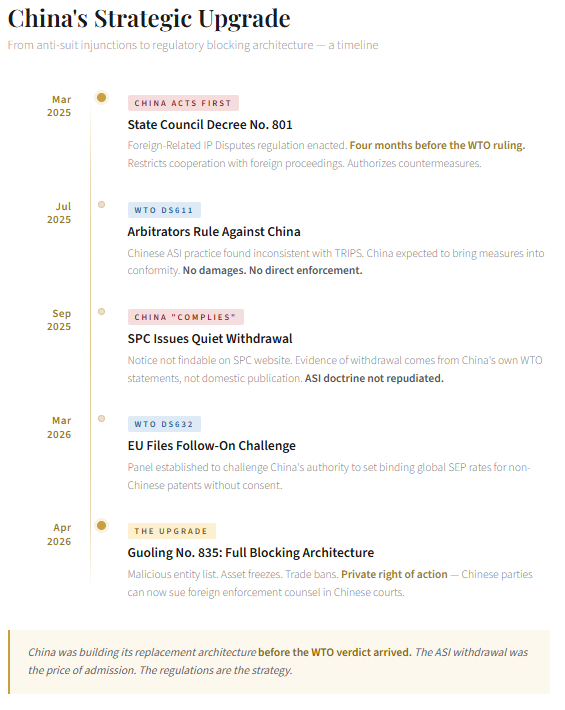
The shift is from a visible, case-by-case judicial tool that was vulnerable to WTO challenge, to a systemic regulatory architecture that is prospective, administrative, and far harder to contest through dispute settlement. China did not retreat from the contest over who sets global FRAND rates. It upgraded its position.
For SEP licensors the practical consequences are direct: the enforceability gap between winning a global FRAND determination and collecting on it is widening; holdout behavior now has regulatory cover; and forum selection strategy must account for the real possibility that a favorable UK High Court ruling is unenforceable in the markets that matter most. A follow-on WTO dispute, DS632, has been filed by the EU challenging China’s authority to set binding global SEP rates without both parties’ consent, but that case will take years and faces the same structural compliance ambiguity that DS611 produced.
The deeper issue is jurisdictional fragmentation. The UK, the UPC, the US, and China are each deploying tools to assert or protect their own authority over global licensing outcomes, with no treaty framework to resolve the conflicts between them. The fight in SEP licensing is no longer primarily about what FRAND means. It is about who gets to decide.
A WTO Dispute Is Not a Court Judgment
DS611 was a formal WTO dispute, meaning a state-to-state complaint, not a private lawsuit. The EU filed against China alleging that Chinese anti-suit injunction practice violated TRIPS obligations around effective enforcement and access to judicial remedies. The WTO case page is at link.
It is worth being precise about what TRIPS actually requires in this area, because the obligations are less absolute than they are often described. The full WTO overview of TRIPS enforcement provisions is at link. The core provision is Article 41, which requires that WTO members make available enforcement procedures that permit effective action against infringement, with remedies that are expeditious and constitute a deterrent to further infringement. Article 41 also requires that these procedures be fair and equitable, and not unnecessarily complicated, costly, or subject to unreasonable delays. Critically, Article 41 is a minimum standards obligation. Members must meet the floor, but the agreement explicitly does not create an obligation to put in place a judicial system for IP enforcement distinct from enforcement of law in general.
The second obligation at issue in DS611 came from Article 63, which requires transparency: laws, regulations, and final judicial decisions of general application pertaining to IP must be published or otherwise made available. It was under Article 63 that the arbitrators found China had failed to publish or make accessible decisions, including Xiaomi v. InterDigital, that articulated principles guiding future cases. The full TRIPS text, including Article 63, is at link.
The EU’s argument was that China’s ASI practice, by blocking SEP holders from pursuing litigation abroad and imposing coercive financial penalties for doing so, effectively denied rights holders access to the enforcement procedures they were entitled to under Article 41. That argument ultimately prevailed on appeal, though not without real legal tension, as discussed below.
The process runs through several stages: consultations between the parties, establishment of a panel, issuance of a decision, and nominally an appellate stage. I say nominally because the WTO Appellate Body has been effectively dysfunctional since 2019, when the United States blocked the appointment of new members. That dysfunction hasn’t stopped dispute resolution entirely. DS611 proceeded under an Article 25 alternative arbitration arrangement, with the arbitrators issuing their award in July 2025, but it has changed the character of outcomes.
There are no damages. There is no direct enforcement mechanism. The losing party is expected to bring its measures into conformity; if it doesn’t, retaliation may be authorized. In practice, WTO outcomes are often political settlements wearing legal clothing. Governments adjust behavior without admitting wrongdoing, the complaining party declares satisfaction, and the case moves toward closure. That process creates exactly the kind of ambiguous compliance space China has now exploited.
One important nuance worth noting: the WTO panel in early 2025 initially rejected most of the EU’s substantive claims. It was the arbitral appeal, decided in July 2025, that reversed those findings and concluded that Chinese ASI practice was inconsistent with the TRIPS Agreement. Even then, the arbitrators’ reasoning on what constitutes a “final judicial decision of general application” that must be published under Article 63 has been legitimately criticized as stretching a vague TRIPS obligation beyond its institutional context. China does not operate a formal common law precedent system, and a first-instance provincial decision, even an influential one, does not carry binding effect across the Chinese judicial system. That is a real tension in the ruling, and acknowledging it honestly does not undermine the broader argument. It sharpens it: even a ruling with debatable reasoning produced only ambiguous compliance.
What DS611 Was Actually Contesting
The official framing of DS611 was about anti-suit injunctions, those orders issued by Chinese courts, most notoriously the Wuhan Intermediate Court in Xiaomi v. InterDigital, that blocked SEP holders from pursuing litigation abroad, backed by daily fines reaching RMB 1 million for non-compliance. The arbitrators concluded that Chinese ASI practice altered the process of FRAND negotiation in a fundamental way, diminishing SEP holders’ ability to conclude licensing agreements and impacting their negotiating position when filing suits outside China.
But the real dispute beneath the legal pleadings was simpler and more fundamental: who gets to set global FRAND rates?
When a UK court asserts jurisdiction to determine a global FRAND license, as it has done repeatedly, that is a claim of sovereign authority over royalty outcomes that affect Chinese manufacturers, Chinese supply chains, and Chinese industrial policy. From Beijing’s perspective, this is not neutral adjudication. It is extraterritorial reach into a domain China considers its own economic interest. The ASI was the blunt instrument China used to push back. It worked, for a while. But it was also visible, controversial, and ultimately untenable under WTO pressure.
The “Retreat” That Wasn’t
Here is what the record actually shows about China’s response.
The Supreme People’s Court reportedly issued a notice in September 2025 withdrawing the ASI policy and communicated this to the WTO. The EU published its acknowledgment of China’s withdrawal at link. On its face, that looks like compliance.
Look harder. As of early April 2026, the SPC’s notice was not discoverable through ordinary searches of the SPC website or the SPC IP Tribunal site, a pointed irony given that the dispute itself turned partly on judicial transparency obligations under TRIPS Article 63. The clearest evidence of withdrawal came not from a prominent SPC publication, but from China’s own statements at the WTO (link) and the EU’s reporting of those statements. Meanwhile, SPC and SPC IP Tribunal materials have continued to describe and even celebrate the development of ASI practice. The doctrine has not been dismantled. The cases have not been repudiated. The Wuhan government’s summary of Xiaomi v. InterDigital, proudly labeling it the “world’s first cross-border anti-suit injunction,” remains online at link.
China appears to have taken the position that there never was a written ASI policy to begin with, which conveniently makes withdrawal of a nonexistent policy consistent with maintaining the underlying doctrine. Whether an anonymized publication of a possibly non-permanent link constitutes meaningful compliance with TRIPS Article 63 transparency obligations is a question the arbitrators did not fully anticipate, and the SPC has not rushed to resolve it. Mark Cohen’s detailed analysis of this compliance gap is at link.
As of early April 2026, Mark Cohen, one of the most closely watched observers of Chinese IP practice, reported no awareness of new Chinese SEP anti-suit injunctions since the July 2025 ruling, though given the transparency failures at the heart of DS611 itself, absence of observed activity is not the same as confirmed absence.
This is not compliance. It is recalibration. China has done exactly enough to satisfy the formal WTO compliance process while preserving its ability to revisit these tools if circumstances change. And the reason it can afford to make that trade is that it has already built something more durable to replace them.
Two Regulations, One Strategy
While DS611 attracted most of the attention, the more consequential developments arrived in two legislative waves, the second of which landed just this month.
The first came in March 2025, when China’s State Council enacted Decree No. 801, the Regulations on Resolving Foreign-Related Intellectual Property Disputes. Analysis of that regulation is at link. Binding on both administrative agencies and courts, it constructed the initial framework: restrictions on cooperating with foreign evidence requests, authorization for countermeasures against countries using IP procedures to “contain or suppress China,” and prohibitions on Chinese entities assisting foreign governments in what the regulation characterizes as discriminatory proceedings. Articles 12 through 17 were the operational core, with trigger conditions deliberately broad enough to cover most global FRAND determinations by a foreign court.
The second wave arrived April 7, 2026: State Council Decree Guoling No. 835, the Regulations on Countering Unjustified Foreign Extraterritorial Jurisdiction. The full Chinese text is at link, with an English translation available at link. Signed by Premier Li Qiang and effective immediately upon publication, this is 20 articles of purpose-built blocking architecture. It is not an amendment or extension of the 2025 regulation. It is a distinct and more operationally aggressive instrument, and it goes materially further in three respects that matter directly for SEP licensing.
First, it establishes a malicious entity list, a formal registry of foreign organizations and individuals deemed to participate in implementing extraterritorial jurisdiction measures against China. The trigger for listing is not criminal conduct. It is participation in enforcing a foreign measure that China has formally identified as constituting unjustified extraterritorial jurisdiction. A patent licensor, its counsel, or a licensing pool administrator enforcing a UK global FRAND determination against a Chinese implementer is not obviously outside the scope of that provision.
Second, it authorizes a graduated countermeasure toolkit: asset freezes, trade bans, visa denials, and blacklisting, deployed against foreign entities that harm Chinese interests through extraterritorial reach. These are not aspirational. They are named instruments in a regulation that is already in force.
Third, and most consequentially, it creates a private right of action, allowing Chinese citizens and organizations affected by foreign extraterritorial measures to bring lawsuits against those enforcing them in Chinese courts, with government authorities directed to provide guidance and support for such actions. A Chinese implementer subject to a UK global FRAND determination could potentially invoke this provision to sue the licensor’s enforcement counsel in China. That is a structural deterrent to enforcement that operates independently of any government action. It is self-executing litigation risk embedded in domestic law.
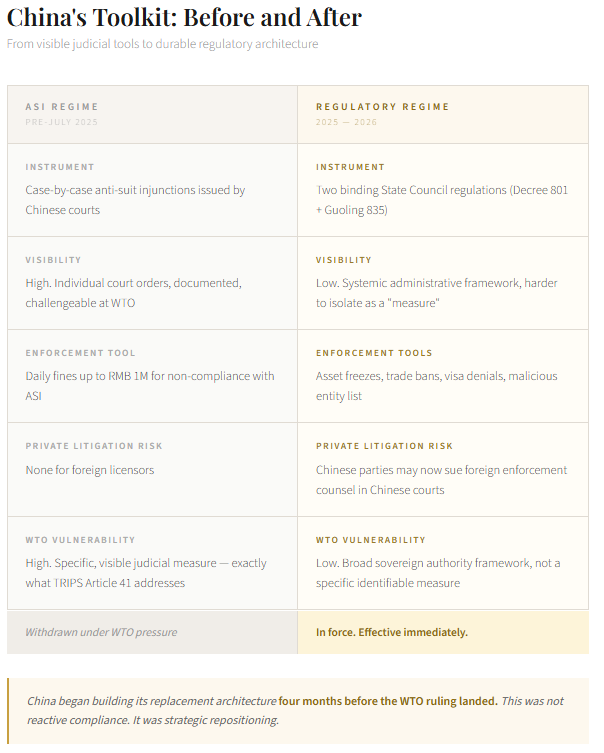
Taken together, the two regulations represent a coherent strategic architecture: the 2025 instrument built the policy framework, and the 2026 instrument gave it enforcement teeth. The question of whether a given foreign proceeding constitutes “unjustified extraterritorial jurisdiction” sits with the State Council legal affairs department, which may conduct investigations and issue public announcements. Once a measure is formally identified, Chinese organizations are prohibited from implementing or assisting in its enforcement, and may only proceed upon State Council approval.
One analyst characterized the 2025 regulation as China preparing for “IP lawfare.” The April 2026 regulation is not preparation. It is the opening position.
The Structural Shift: From Judicial to Regulatory Tools
The strategic logic deserves to be made explicit, because it represents a genuine evolution in how China engages this space.
Anti-suit injunctions were a judicial instrument. They were issued case-by-case, required individual enforcement, and were highly visible. That visibility made them politically costly, as they handed the EU a concrete, documentable grievance suitable for WTO dispute settlement under TRIPS Article 41.
The new regulatory framework is different in kind. It is systemic rather than episodic, administrative rather than judicial, and prospective rather than reactive. A Chinese company facing a UK global FRAND determination no longer needs a court to issue an ASI. It can invoke the regulatory framework to decline compliance, require State Council approval before taking any action under a foreign judgment, and potentially trigger countermeasures against the opposing licensor, including placement on the malicious entity list.
The shift is from blocking individual lawsuits to blocking the enforceability of entire categories of foreign decisions. That is a more durable position and, critically, one that is far harder to challenge through WTO dispute settlement, which is designed to address specific identifiable measures, not pervasive regulatory frameworks operating under broad sovereign authority claims.
The Complicating Factor: Nobody Has Clean Hands
ASIs are not a Chinese invention, and the jurisdictional picture has grown genuinely complicated in ways that deserve honest acknowledgment.
US and UK courts have used anti-suit injunctions for decades. The UPC has now developed anti-anti-suit injunctions, orders designed to prevent parties from seeking or enforcing foreign ASIs that would interfere with UPC proceedings, issued in disputes including Huawei v. Netgear and Broadcom v. Realtek in late 2024. In early 2025, the UPC’s Mannheim Local Division issued an ex parte anti-interference measure in InterDigital v. Amazon. The UK High Court responded with its own counter-order, restraining enforcement of those continental measures insofar as they affected UK proceedings. Multiple jurisdictions are now deploying overlapping tools to protect their own authority over rate-setting and enforcement.
The tool itself, in other words, is not the problem. What distinguished the Chinese ASIs in DS611 was a specific combination of factors: thin jurisdictional nexus, with Chinese courts asserting global rate-setting authority over portfolios with limited Chinese connection; aggressive running financial penalties designed to coerce rather than compensate; and proceedings issued without adequate notice to the SEP holder. The problem was the strategic purpose, which was systematically suppressing licensor access to legitimate foreign forums in violation of the Article 41 minimum standards that TRIPS guarantees. The new regulatory framework pursues the same objective through machinery that is harder to see and harder to challenge.
It is also worth noting that the USTR’s position in DS611, arguing against expansive transparency obligations under TRIPS Article 63, was a departure from over thirty years of bipartisan US policy encouraging China toward greater judicial openness. The arbitrators rejected that approach, which was the right outcome. But it is a reminder that the Western position on these disputes has not always been internally coherent, and that critics who point to Western jurisdictional overreach are not entirely wrong. The difference is that Western courts’ claims to global rate-setting authority, whatever their faults, are grounded in parties voluntarily submitting to jurisdiction as an alternative to injunction. China’s blocking framework is coercive by design. It operates without consent and against parties who have no meaningful connection to the Chinese regulatory process.
DS632: The Fight Continues
China’s partial compliance with DS611 has not ended the WTO track. In February 2026, the EU requested a panel in DS632, a follow-on challenge to China’s claimed authority for its courts to set binding worldwide SEP licensing terms, including royalty rates covering non-Chinese patents, without both parties’ consent. The DS632 case page is at link. The WTO established the panel on March 19, 2026. A substantial roster of third parties has reserved rights: Australia, Brazil, Canada, India, Japan, Korea, the UK, the US, and others.
DS632 goes to the core question that DS611 danced around. It is not about the procedural tool, the ASI, but about the substantive claim: does a Chinese court have the authority to set global rates for a patent portfolio that includes rights registered in other jurisdictions, without consent from both parties? The EU’s answer is no. China’s implicit answer, embedded in its prior practice and now given regulatory architecture, is yes, and the April 2026 regulation has effectively made that answer self-enforcing.
DS632 will play out over years. But its establishment confirms that the WTO track remains live and that the jurisdictional competition is not resolving. It is escalating. And the new blocking regulations will complicate DS632’s practical impact in exactly the same way they complicated DS611’s: China can adjust surface behavior while embedding structural resistance in domestic law.
What This Means for SEP Licensing
For patent holders, the practical implications are not abstract.
The enforceability gap is widening. A global FRAND determination favorable to a licensor is worth less in a world where the implementer can invoke a State Council regulation to block compliance, require government approval for any action under a foreign judgment, or expose the licensor’s enforcement counsel to placement on a malicious entity list. The legal win and the commercial outcome are increasingly decoupled.
Holdout behavior now has regulatory cover. The new framework does not merely give implementers leverage in individual negotiations. It creates systemic friction that shifts the balance in every negotiation involving a Chinese party. Holdout was already a structural problem in SEP licensing. It just got a regulatory backstop with enforcement teeth.
Forum selection has never mattered more, or been more constrained. The traditional playbook for patent holders, choosing favorable forums, obtaining injunctions or global FRAND rates, and using that leverage to drive settlements, depends on enforcement. As enforcement becomes jurisdiction-dependent and cross-border enforceability degrades, the value of favorable rulings declines accordingly. A UK High Court global FRAND determination is an increasingly powerful piece of paper in London and an increasingly uncertain one in Shenzhen.
It is also worth noting, against the persistent claim that SEP licensing regulation is addressing a real innovation harm, that the empirical literature does not support that premise. Research in the competition policy literature has found no credible evidence that SEP licensing practices have suppressed innovation or harmed the development of standards. The regulatory interventions now reshaping this space are driven by distributional concerns and industrial policy, not evidence of market failure. That matters because it clarifies what is actually at stake: sovereign control over the economics of innovation markets, not consumer protection.
The Fragmentation of Global SEP Enforcement
After two decades in this space, I have watched the SEP licensing debate move through several phases, from early FRAND rate-setting disputes, through the hold-up vs. holdout wars, through pool governance debates, to the current moment where the underlying question is no longer doctrinal. It is jurisdictional.
The UK courts assert authority to set global FRAND rates. The UPC is developing anti-interference tools to protect its own proceedings. China has withdrawn its ASIs under WTO pressure while constructing a two-layer regulatory blocking framework. The US position remains in flux. There is no single forum that controls global licensing outcomes. There is no treaty that allocates jurisdiction over global FRAND rate-setting. There is no enforcement mechanism that operates across all relevant markets.
What exists instead is a fragmented landscape of competing authorities, each with its own tools and each motivated to expand its jurisdictional reach. The WTO can adjudicate whether specific practices violate TRIPS. It cannot answer the deeper question: which court, in which country, has the right to determine what a global standard is worth?
The Question Is No Longer What FRAND Means
For most of the last two decades, the fight was about doctrine: FRAND rates, comparables, injunctions, smallest salable patent-practicing units. Those questions remain important. But they have been overtaken by something more fundamental.
The real fight is about who decides. Which courts have the authority to set global rates? Whose judgments are enforceable across jurisdictions? Which regulatory framework gets to define what counts as discriminatory IP practice?
China did not retreat from that contest when it pulled back its ASIs. It moved to higher ground, from a position legally vulnerable under WTO frameworks to one structurally more durable and far harder to challenge. The 2025 regulation built the policy architecture. The April 2026 regulation gave it enforcement teeth. Neither is a placeholder. Together, they represent a long-term strategic position on who controls the economics of global standards.
The fragmentation of global SEP enforcement is not a risk on the horizon. It is the current reality. And the question facing every participant in this ecosystem, licensors, implementers, courts, and policymakers alike, is not whether to engage with that fragmentation, but how.
For patent holders who have built their businesses on the premise that global standards create global licensing rights, that question has never been more urgent.
Standards at Risk covers the intersection of patent licensing, global standards policy, and the strategic dynamics shaping the future of innovation markets.