
Tesla v. InterDigital and Avanci: What the UK Supreme Court Hearing Actually Decides
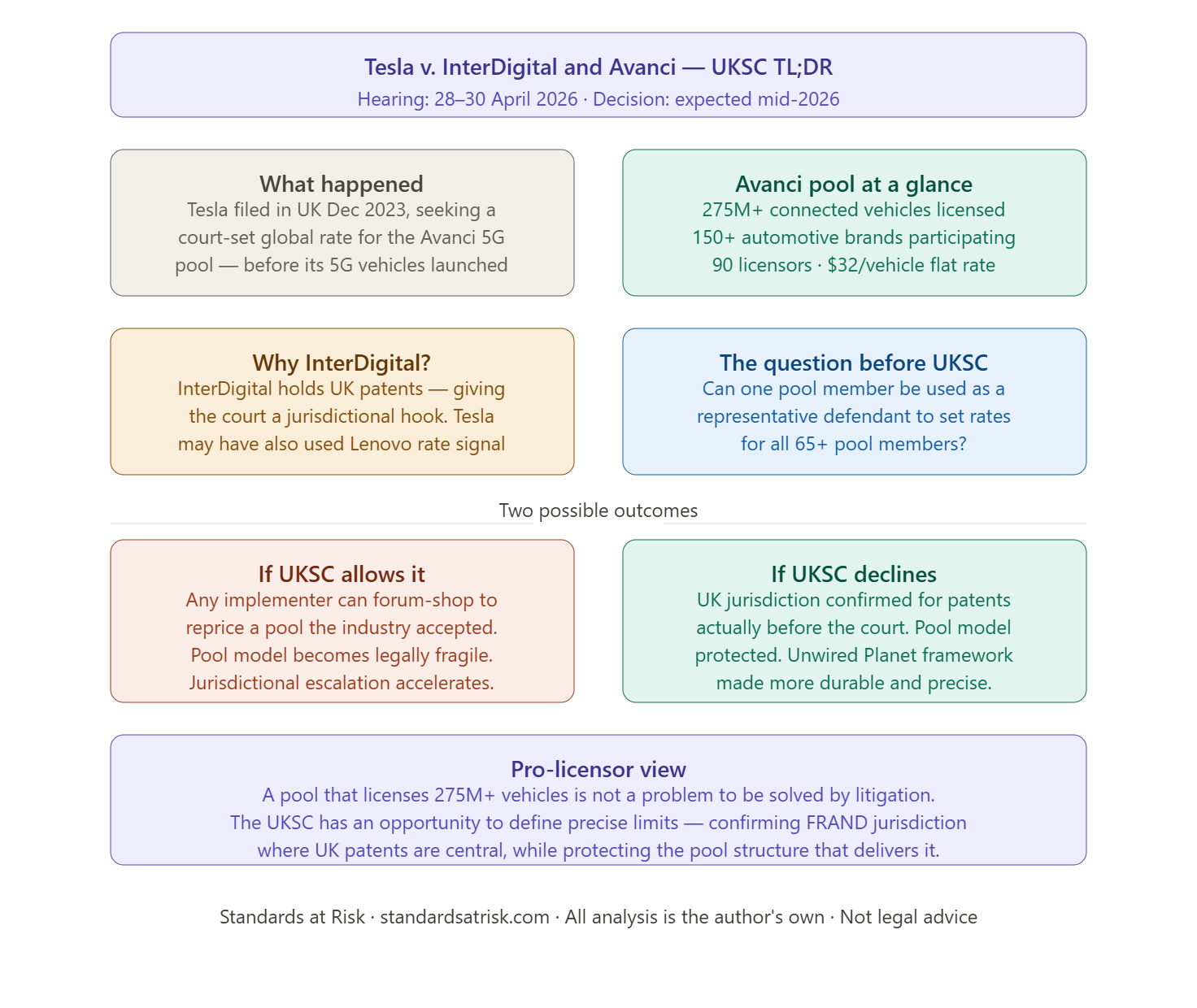
The question before the court is not whether patent pools work. The evidence on that is in. The question is whether one holdout can use judicial machinery to reprice what 150 automotive brands have al

Why Tesla Filed in the UK and Why It Matters
In December 2023, Tesla filed proceedings in the UK High Court seeking two things: declarations that several InterDigital patents are invalid or non-essential, and a court determination of FRAND terms for a license to the entire Avanci 5G Vehicle platform.
The “why UK” question has a plausible answer once you understand the procedural logic. Under the framework established by Unwired Planet v. Huawei and affirmed in subsequent cases, UK courts will set global FRAND rates for portfolios that include UK patents. Tesla may have chosen InterDigital as the anchor defendant in part because InterDigital holds UK patents, giving the court a potential jurisdictional hook. Tesla then attempted to use InterDigital as a representative defendant under CPR rule 19.8 to bring all 65-plus Avanci pool members within the court’s reach in a single proceeding. One hearing, one rate, covering approximately 11,900 UK SEPs across the entire connected vehicle pool.
Tesla’s own filings suggest the motivation. It says it was pressured into taking a 4G Avanci license by litigation from pool members seeking injunctions that threatened to bar its 4G-enabled vehicles from important markets. It filed in the UK for 5G more than a year before its 5G vehicles were ready to deploy, suggesting a pre-emptive posture aimed at getting a court-determined rate before similar pressure could be applied again.
The rate in dispute is $32 per vehicle, which is Avanci’s flat-rate offer for a license to the 5G platform. Tesla contends this exceeds a FRAND rate and was presented on a non-negotiable basis. Avanci’s response is that the rate reflects a transparent, one-stop-shop structure that more than 150 automotive brands worldwide have accepted across its 4G and 5G programs, and that Tesla is not being asked to pay anything different from what every other vehicle manufacturer pays.
What the Courts Below Found
Both the High Court and the Court of Appeal declined to permit Tesla’s FRAND determination claim against InterDigital as a representative defendant for all Avanci pool members. The procedural mechanism extends the court’s reach from the patents actually before it to an entire pool built around 65-plus independent companies, the vast majority of whom never submitted to UK jurisdiction at all.
The Avanci Case: A Pool That Works Is Not a Problem to Be Solved
The numbers here are worth stating plainly, because they are the most important context for understanding what is actually at stake in this hearing.
Avanci’s 4G and 5G Vehicle programs together cover more than 275 million connected vehicles worldwide. More than 150 automotive brands participate across both programs. The 5G program alone involves approximately 90 licensors and has brought in Toyota, General Motors, Volkswagen, Ford, Volvo Cars, Honda, Jaguar Land Rover, Nissan, and most recently seven Chinese automakers in agreements announced in March 2026. The Court of Appeal’s own record notes the contrast between the “orderly licensing” Avanci achieved in the automotive sector and the “licensing debacle” in the mobile phone sector where no comparable pool exists.
This is a pool that is working. The automotive industry has accepted it overwhelmingly. The rate structure is transparent, non-discriminatory, and applied equally to every licensee from the largest European manufacturer to the newest Chinese entrant. The pool has even extended its model to Wi-Fi 6, launching a new program in March 2026 with Mercedes-Benz as the inaugural licensee.
Tesla’s position is that the $32 per vehicle rate is too high and was offered on a take-it-or-leave-it basis. Those are legitimate commercial concerns. But the mechanism Tesla chose to address them raises a question about whether it constitutes a FRAND compliance remedy or something closer to a litigation strategy that, if successful, could give any automotive manufacturer the option of seeking judicial repricing of a pool that the rest of the industry has accepted through negotiation. The mechanism involves UK litigation seeking a court-imposed rate covering all 65-plus pool members through a procedural device that bypasses their individual consent to jurisdiction.
The downstream effect on the pool model is worth considering as an under-discussed consequence of a Tesla win at the UKSC. If a single implementer can anchor UK jurisdiction to one pool member and then seek a globally binding rate covering all pool participants, the incentive for other implementers to negotiate bilaterally may be diminished. The bilateral alternative, meaning individual negotiation with each of 65-plus patent holders, is precisely what Avanci was built to avoid, and what Avanci’s own counsel described as the “licensing debacle” in mobile. A UKSC decision that enables the Tesla model could make the pool model more legally fragile at exactly the moment when it is demonstrably succeeding.
Why InterDigital and Why December 2023
One question worth addressing directly is why Tesla may have chosen InterDigital as the anchor defendant and why it filed when it did.
The timing is not coincidental. In March 2023 the UK High Court issued its first instance decision in InterDigital v. Lenovo, setting a global FRAND rate of $0.225 per device for InterDigital’s cellular SEP portfolio. That figure was ultimately ~65% below InterDigital’s ask and far closer to Lenovo’s position. The High Court also found that InterDigital had not acted as a willing licensor, having consistently sought supra-FRAND rates during negotiations. Tesla filed its UK proceedings in December 2023, nine months after that decision entered the public record.
The timing invites a plausible inference. InterDigital was arguably the most prominent Avanci pool member against whom a UK FRAND rate had been publicly determined. Tesla’s apparent strategy may have been to use InterDigital as a jurisdictional anchor, with its UK patents giving the court a potential hook, and then argue that a judicially determined automotive rate would be materially lower than Avanci’s $32 flat offer, using the Lenovo cellular rate as a possible reference point. One pool member, one UK filing, one rate covering the entire platform.
The problem with that strategy, beyond the representative defendant jurisdictional question that defeated it at first and second instance, is that the Lenovo rate is a poor comparator for the Avanci automotive context for reasons the subsequent record makes clear.
The Court of Appeal in July 2024 corrected the first instance rate materially upward to $0.30 per device and increased the total lump sum Lenovo must pay to over $240 million, roughly three times Lenovo’s original offer. InterDigital itself described the Court of Appeal outcome as a resounding victory. Both the UK High Court in subsequent proceedings and the Munich Regional Court explicitly cautioned against using the Lenovo decision as a forward-looking rate reference. Justice Reynolds noted he did not “have a high degree of assurance that this is a FRAND rate” for any future license, and Munich observed that at least a 30% inflation uplift would be mandatory for any forward-looking calculation.
There is a deeper structural problem with Tesla’s comparator argument. The Lenovo decision covered a cellular SEP portfolio licensed to handset manufacturers, a market with decades of licensing history, established comparable transactions, and well-developed royalty benchmarks. The Avanci 5G Vehicle platform covers connected vehicle technology across a pool of approximately 90 licensors offering a transparent, non-discriminatory flat rate to an automotive industry that had never previously navigated multi-licensor cellular SEP licensing at scale. The technology layer, the licensing context, the implementer base, and the pool structure are all materially different. A cellular handset rate is not a comparable for a connected vehicle pool rate, and the courts recognized that Tesla was attempting to use one rate-setting exercise as a lever to reach a completely different licensing environment.
One reasonable reading of Tesla’s strategy is that it attempted to use a single backward-looking rate determination, one that was subsequently corrected on appeal, as a template for seeking judicial pricing on a pool that 150-plus automotive brands had already accepted through negotiation. The UK courts declined to allow that mechanism to succeed at either instance level. The UKSC will now decide whether the jurisdictional question that enabled the attempt in the first place should remain available to implementers in future pool disputes.
The Jurisdictional Escalation Context
This hearing does not occur in isolation. It occurs against a background of accelerating jurisdictional conflict over who controls the global licensing environment for standard-essential technology, a conflict this publication has analyzed in prior Standards at Risk articles on China’s regulatory response to WTO dispute DS611.
The relevant context is this: the UK’s extraterritorial FRAND rate-setting ambition, established in Unwired Planet and developed through the Optis and InterDigital v. Amazon cases, has prompted regulatory counter-moves in other jurisdictions. China’s courts began setting their own global FRAND rates. That led to anti-suit injunctions, counter-injunctions, and eventually the Munich Regional Court’s unprecedented pre-emptive anti-interference order. The UPC has issued its own ASIs affecting UK proceedings. The European Commission was formally notified of one such order in December 2025.
The possibility of a WTO complaint against the UK over its FRAND rate-setting practice has been raised in commentary on this hearing. That risk may not be trivial. The EU’s DS611 complaint against China was premised on China’s use of ASIs to suppress royalty rates for cellular SEPs. A structural argument could potentially be developed that the UK’s extraterritorial rate-setting constitutes an analogous distortion, allowing implementers to forum-shop for a favorable judicial determination. Whether such an argument would succeed is a separate question, but a jurisdiction representing approximately 3% of global GDP that is setting licensing terms for technology deployed worldwide may face legitimate questions about the international standing of that practice.
The pro-licensor reading of this dynamic is not that UK courts should stop setting FRAND rates. It is that the framework needs to be stable, internationally recognized, and limited to cases where UK patents are genuinely central, rather than cases where UK patents are used as a procedural hook to reach an entire pool most of whose members have no UK connection.
What a Durable Outcome Looks Like
The UKSC is not being asked to overturn Unwired Planet. It is being asked to define the outer boundary of the representative defendant mechanism in the pool context. That is an opportunity to improve the framework rather than simply affirm or reverse it.
A durable outcome from a pro-licensor and pro-pool perspective might do three things.
First, it would confirm that UK courts can set FRAND rates for patents actually litigated before them. That is settled law and should remain so. The Avanci model benefits from a predictable judicial backstop. Licensees who refuse bilateral negotiation can be brought before a court, and the existence of that option is part of what makes the pool’s take-it-or-leave-it offer credible.
Second, it would decline to extend the representative defendant mechanism to pool members who have not individually submitted to UK jurisdiction. The pool structure works because participation is voluntary and the rate is transparent. Allowing one member to be used as a procedural proxy for all others removes the individual consent that makes pool governance legitimate. This is not a limitation on UK FRAND jurisdiction. It is a recognition that jurisdiction follows the patents, not the pool.
Third, it would do so in terms that are internationally legible, acknowledging the jurisdictional escalation dynamic and signaling that UK courts are not seeking to set rates for technology whose primary markets lie elsewhere. That signal matters not just for future litigation but for the diplomatic and regulatory environment in which UK courts operate.
Tesla has a legitimate interest in paying a FRAND rate. Avanci has a legitimate interest in maintaining a pool structure that has delivered orderly licensing to more than 275 million connected vehicles. Both interests can be served by a framework that gives Tesla access to UK patent validity and essentiality determinations, which the courts below did not foreclose, while declining to give it a mechanism to impose a judicially determined rate on 65-plus independent companies that never consented to UK jurisdiction.
The UKSC has an opportunity to make the Unwired Planet framework more durable by defining its limits with precision. A maximalist affirmance of the representative defendant mechanism could extend UK reach in ways that accelerate the jurisdictional conflict it has already generated, while potentially making the pool model more legally fragile at exactly the moment when it is demonstrably succeeding.
The Broader Stakes for Patent Pools
The Avanci story is worth dwelling on because it is the best empirical evidence available for what a well-functioning SEP licensing structure looks like in a complex multi-technology, multi-licensor environment.
More than 275 million connected vehicles. More than 150 automotive brands. Approximately 90 licensors in the 5G program. Seven Chinese automakers joining in March 2026 alone. A new Wi-Fi 6 program launched with Mercedes-Benz. The contrast with the mobile phone sector’s bilateral licensing friction, which produced years of multi-jurisdictional litigation involving Apple, Huawei, Samsung, Ericsson, Nokia, and others, is exactly as stark as Avanci’s counsel described it.
Patent pools work when they offer transparent, non-discriminatory rates that reduce transaction costs for everyone. Avanci has done this in the automotive sector. The question before the UKSC is whether the pool model is protected by a legal framework that respects its structure, or whether any single holdout can use judicial machinery to reprice what the rest of the industry has negotiated and accepted.
That question matters well beyond Tesla and Avanci. The connected vehicle sector is arguably the first major proving ground for SEP licensing in non-handset contexts. The IoT sector, the industrial automation sector, and the smart infrastructure sector all face similar challenges: how do you efficiently license standard-essential technology across thousands of implementers without the bilateral licensing friction that characterized the mobile era? Patent pools represent one market-developed answer. The UKSC hearing may well reinforce or undermine the legal foundation on which that answer rests.
The UK Supreme Court hearing in Tesla v. InterDigital and Avanci runs from 28 to 30 April 2026. A decision is expected in the months following. Standards at Risk will analyze the ruling when it issues.
Sources: UK Supreme Court case record UKSC/2025/0058; Court of Appeal judgment [2025] EWCA Civ 193; High Court judgment [2024] EWHC 1815 (Ch); Avanci Vehicle program announcements March 2026; ICLE intervention brief March 2026; Lawyer Monthly, March 2026. All analysis is the author’s own. This is not legal advice.