
The Prediction Was Correct
InterDigital and Amazon announced a patent license agreement today, June 11, 2026. Here is what this series got right, what it got wrong, and what comes next.

What Was Announced
This morning InterDigital published the following on Globe Newswire:
“InterDigital, Inc. today announced that it has entered into a patent license agreement with Amazon, covering Amazon’s services and devices, including Amazon Prime Video. The parties have agreed to resolve all pending litigation and will enter into binding arbitration to determine the final terms of the new agreement.”
That is the Samsung January 2023 announcement structure, word for word.
Binding arbitration to determine final terms.
All pending litigation resolved.
Revenue recognition begins immediately at a conservative level.
The final award comes in approximately 18 to 24 months -- call it late 2027 to mid-2028 based on the Samsung (30 months) and Lenovo (18 to 24 months) precedents.
The market confirmed the two-layer framework in real time:
IDCC surged as much as 18 percent intraday on the announcement. As of mid-morning the stock was up approximately 9.6 percent. This on a stock that had been down 29 percent over the prior six months, trading at $253.91 before the announcement.
The market did not wait for the arbitration award. It did not wait for the final streaming services rate. It moved on the announcement alone -- exactly as the Samsung January 2023 precedent predicted. The two-layer framework the series identified in Part 5 is not just analytically correct. The market price action confirms it. The announcement is the economic event. The award is the true-up.
Amazon already held a device-level license from InterDigital covering WLAN and related device technologies -- confirmed by InterDigital’s own Q4 2024 investor materials. The streaming litigation was a completely separate workstream. InterDigital launched its Video Services licensing program as a new initiative targeting streaming platforms as a distinct licensee category that had never previously been licensed. The enforcement campaign against Amazon was InterDigital asserting that streaming services require a separate license independent of any prior device license -- not a failed renegotiation of the prior deal.
Today’s announcement covers “Amazon’s services and devices, including Amazon Prime Video.” That language bundles the device component and the new streaming services license together under a single agreement. The multi-forum enforcement campaign across six jurisdictions was the mechanism that brought Amazon to the streaming licensing table. The device component was always going to renew. The structural question was always whether streaming would be in scope under a new and separate license.
It is.
InterDigital’s July 2024 Google license -- covering cellular wireless, Wi-Fi, and HEVC video on consumer devices -- is the device-only template. The Amazon agreement adds streaming services on top of that foundation.
What the Series Predicted
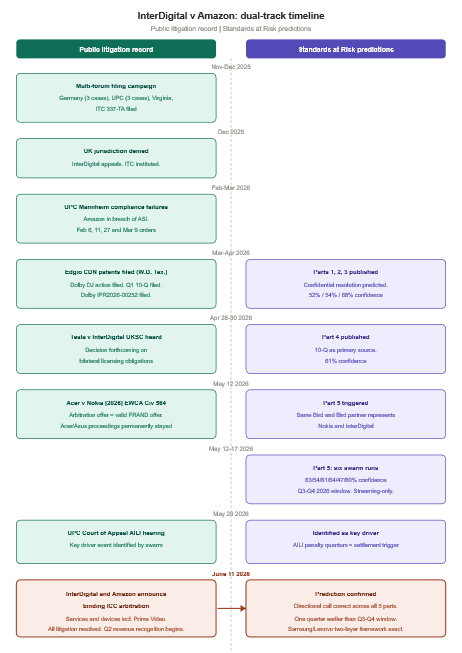
This series ran across five published parts from March to May 2026, using a ten-agent Python swarm to reason over an evolving fact base. The prediction was consistent across all five parts: confidential global resolution, not a public FRAND judgment. The mechanism, timing, and confidence evolved with each run.
Here is the complete prediction record:
Part 1 (March 2026): Confidential global license, Q4 2026. Confidence: 52 percent. Primary seed document: a single JUVE Patent article. Key driver: UPC penalty exposure. The prediction was directionally correct. The timing was off by one quarter -- the announcement came in Q2 2026, two quarters earlier.
Part 2 (April 2026): Corrected the Delaware companion case error from Part 1. Added the full US docket picture. Confidence: 54%. Directionally correct.
Part 3 (April 2026): Added the validity challenge layer, the ITU Common Patent Policy analysis, and the regulatory flanking analysis. Confidence: 68%. This was the high-water mark of the series and, in retrospect, the most accurate single run in terms of direction and confidence.
Part 4 (April 30, 2026): First run anchored to an SEC-filed primary source -- InterDigital’s Q1 2026 10-Q. Added the Samsung ICC award, the Dolby California DJ action, the German court trial schedule, and the AV1 correction. Confidence: 61%.
Part 5 (May 12 to May 17, 2026): Triggered by the UK Court of Appeal’s May 12 judgment in Acer v Nokia, [2026] EWCA Civ 564. Ran six separate swarm iterations incorporating the Nokia EWCA judgment, the Samsung and Lenovo two-layer announcement framework, the patent fraction stress test, InterDigital’s 2030 ARR streaming channel roadmap, the Amazon existing device license correction, and the streaming industry collective action dynamic. Confidence across the six runs: 63, 54, 61, 64, 47, and 60 percent. Final published confidence: 60% in Q3-Q4 2026. The announcement came in Q2 2026 -- one quarter earlier than the published window.
What the Series Got Right
The directional prediction held across all five parts. Confidential resolution through binding arbitration, not a public FRAND judgment. Every run reached the same conclusion.
The mechanism was precisely right. Part 5 identified the Samsung and Lenovo arbitration announcement as the correct prediction endpoint -- not a final license, but an announcement of binding arbitration followed by conservative revenue recognition. That is exactly what happened this morning.
The streaming services characterization was right. The announcement explicitly covers “Amazon’s services and devices, including Amazon Prime Video.” This confirmed the Part 5 correction that this was InterDigital’s Video Services licensing program enforcement action, not a device patent dispute. Amazon already held a device license. The new agreement covers streaming.
The Bird and Bird connection was right. The same partner who represented Nokia in the Acer v Nokia proceedings represents InterDigital in the Amazon dispute. The Nokia EWCA decision validated the arbitration playbook that InterDigital then deployed.
The streaming licensing strategy was right. The press release describes the agreement as “an important milestone in InterDigital’s longer-term goal to expand into video streaming services licensing.” That language maps directly to the streaming licensing expansion InterDigital described at its September 2024 investor day. The $485 billion addressable market thesis now has its first licensed counterparty.
The Samsung and Lenovo timeline precedent was right. The announcement came on June 11, 2026. The final arbitral award will follow in approximately 18 to 24 months. We will not know the final streaming services rate until late 2027 or mid-2028 at the earliest.
What the Series Got Wrong
The timing was off by one to two quarters. The final published prediction was Q3-Q4 2026. The announcement came in Q2 2026. The prediction window was correct in directional terms -- before the September 2026 UK trial -- but conservative on timing. The May 28, 2026 UPC Court of Appeal hearing on the AILI, identified as the key driver, may have accelerated the timeline even before that hearing concluded.
The confidence numbers were volatile across Part 5. Six runs produced confidence levels ranging from 47 to 64 percent. The volatility reflected genuine uncertainty about endpoint definition. The final published 60 percent was the right number under the correct two-layer framework, but the journey to that number was noisier than it should have been.
The device license correction came late. The earlier Parts treated this as a device patent dispute when I knew better as evidenced in the pleadings. The correction -- Amazon already holds a device license, this is a streaming services enforcement action -- only entered the analysis in Part 5. It should have been in Part 1. Earlier identification of the existing device license would have produced sharper predictions throughout.
What Comes Next: The Q2 2026 Earnings Picture
The announcement today falls in Q2 2026. InterDigital’s Q2 2026 earnings call will reflect this agreement in the same way Q1 2023 reflected the Samsung announcement.
Expect the Q2 2026 10-Q to disclose: revenue recognition from Amazon beginning in Q2 2026 at a conservative level; a statement that the arbitration award is expected to exceed the conservative estimate and require a true-up; updated commentary on the streaming licensing program noting the first major platform license is in place; and reduced litigation expense guidance given the resolution of all pending proceedings across the UK, US, Germany, UPC, and Brazil.
The conservative recognition rate will not be disclosed. The streaming services rate will not be disclosed. The total award value will not be known for approximately 18 to 24 months.
A Note on the Methodology
This series used a ten-agent Python reasoning system to analyze an evolving public record across five published parts and twelve total swarm runs. The system ran on Claude Sonnet 4.6 via the Anthropic API. Each run cost approximately $3.50 to $4.00 at current pricing. Total cost across the series: approximately $45 to $50.
The full Python implementation -- pre-processors, agent architecture, and all supporting code -- is available at github.com/theharlans/standards-at-risk.
The methodology was challenged publicly after Parts 1 and 2. On April 9, 2026, a commentator published a piece titled “Let’s not allow AI slop to pollute the SEP ecosystem” calling the analysis hallucination dressed up as reasoning and offering a public $10,000 bet that the prediction was wrong. In Part 3, several of his substantive corrections were acknowledged and incorporated. He returned in subsequent articles to note the series was still missing key points. The bet was never accepted because engagement was never the point. The analysis was. The announcement this morning speaks for itself.
What This Means for the Streaming Industry
Amazon is now the first major SVOD and AVOD platform to enter a binding patent license agreement under InterDigital’s Video Services licensing program. The arbitral tribunal will determine the streaming services rate on a confidential basis.
Every other streaming platform -- Netflix, Disney Plus, Apple TV Plus, Paramount Plus, YouTube -- is watching. InterDigital now has a licensed counterparty in its streaming services licensing program and a rate-setting process underway that will produce a confidential benchmark. Future licensing conversations with other streaming platforms will reference this agreement.
Whether the streaming licensing theory is legally sound -- whether SEP holders can extract a separate royalty from content delivery platforms independent of device licenses already paid -- will be determined by the ICC tribunal, not by a public court. That question will not have a public answer for 18 to 24 months.
The Dolby dimension:
The Amazon settlement does not resolve the parallel Dolby proceedings. In February 2026, Dolby filed IPR2026-00252 against InterDigital’s US 9,185,268, an HDR patent. In March 2026, Dolby filed two declaratory judgment actions in the Central District of California (Case Nos. 2:26-cv-02269 and 2:26-CV-02270) asking the court to confirm that Dolby’s customers -- including Disney, TCL, and Hisense -- do not infringe six of InterDigital’s HDR patents, or that US 9,185,268 is invalid. Amazon was named as one of those customers. With Amazon now licensed, the Amazon-related motivation for Dolby’s DJ actions falls away -- but the actions themselves continue. Disney, TCL, and Hisense remain unlicensed and Dolby filed on its own behalf, not Amazon’s. The Dolby IPR at the USPTO is entirely unaffected by the Amazon settlement. Patent validity is a public right question that survives any bilateral agreement.
What changes is the commercial dynamic. InterDigital now has a licensed Amazon agreement as a reference point in negotiations with every remaining target. Disney, TCL, and Hisense face a harder argument that the streaming licensing theory is commercially unproven. The Dolby DJ actions and IPR continue, but the ground shifted this morning.
The September 2026 UK FRAND trial has been vacated. The ITC investigation is terminated. The German Regional Court proceedings are withdrawn. The UPC proceedings are suspended. All of the multi-forum enforcement pressure that this series analyzed across five parts resolved this morning with a three-paragraph press release.
That is how InterDigital wins.
Standards at Risk covers SEP licensing, FRAND jurisprudence, and global standards policy. The five-part InterDigital v Amazon series, including all source code for the analytical methodology, is available at standardsatrisk.com. This post is the author’s own analysis. It is not legal or investment advice.