
Trust the Structure
The 6G Call to Action and the standards system America built

On July 29, 2026, the Center for Strategic and International Studies (”CSIS”) hosted the launch of the International Call to Action for 6G Leadership and Security (link HERE), a joint statement signed by 25 governments and coordinated by the National Telecommunications and Information Administration (”NTIA”). At a high level, it commits the signatories to secure the digital infrastructure essential to technological competitiveness, economic prosperity, and national security.
But only half of this makes sense. Governments control spectrum, and the World Radiocommunication Conference in 2027 will be a genuine contest among states. Governments control procurement, network certification, and equipment bans. In the International Telecommunication Union (”ITU”), where decisions are made by member countries, a 25-government coalition has the ability to effect change. In those venues the Call to Action can work, and I want it to.
But the other half where all of the real work is done, rests on a misunderstanding of where standards come from. 6G will not be written in the ITU. The ITU sets requirements for what may call itself 6G and will eventually bless the result, but the technical specifications themselves are written at the 3rd Generation Partnership Project (”3GPP”), the consortium of seven organizational partners that are regional standards bodies whose working groups have produced every cellular generation from 3G onward. And 3GPP has no national delegations. Its 844 members join individually, and the overwhelming majority are companies. Its specifications are assembled from technical contributions submitted by its member companies, thousands per meeting cycle, argued on technical merit by the engineers in the room. Its leadership is elected by those same engineers, and the electorate rewards a sustained record of contribution. Influence in this layer cannot be signed into existence by decree. It is earned, meeting by meeting, in engineering hours that can take years of diligent work.
To its credit, the document knows where the boundary runs. It pledges to “avoid duplication with industry-driven bodies engaged on 6G’s technical development” and to support “market-driven standards development.” The drafters understand that the authorship layer belongs to industry. What follows that concession is a work plan with no instrument that reaches it: points of contact within a month, stakeholder engagement within three, white papers within six, a convening in 2027. Standards surface once, among the twelve-month options, as “coordinating in working with industry to shape and promote global 6G standards.”
The elections for the 2025 to 2027 term, the term in which the first 6G specifications will be drafted, have already been decided and will shape the initial 6G drafts. Across the 25 verified elected positions (three Technical Specification Group (”TSG”) chairs, nine TSG vice-chairs, and thirteen working group chairs), the slate breaks down as follows:
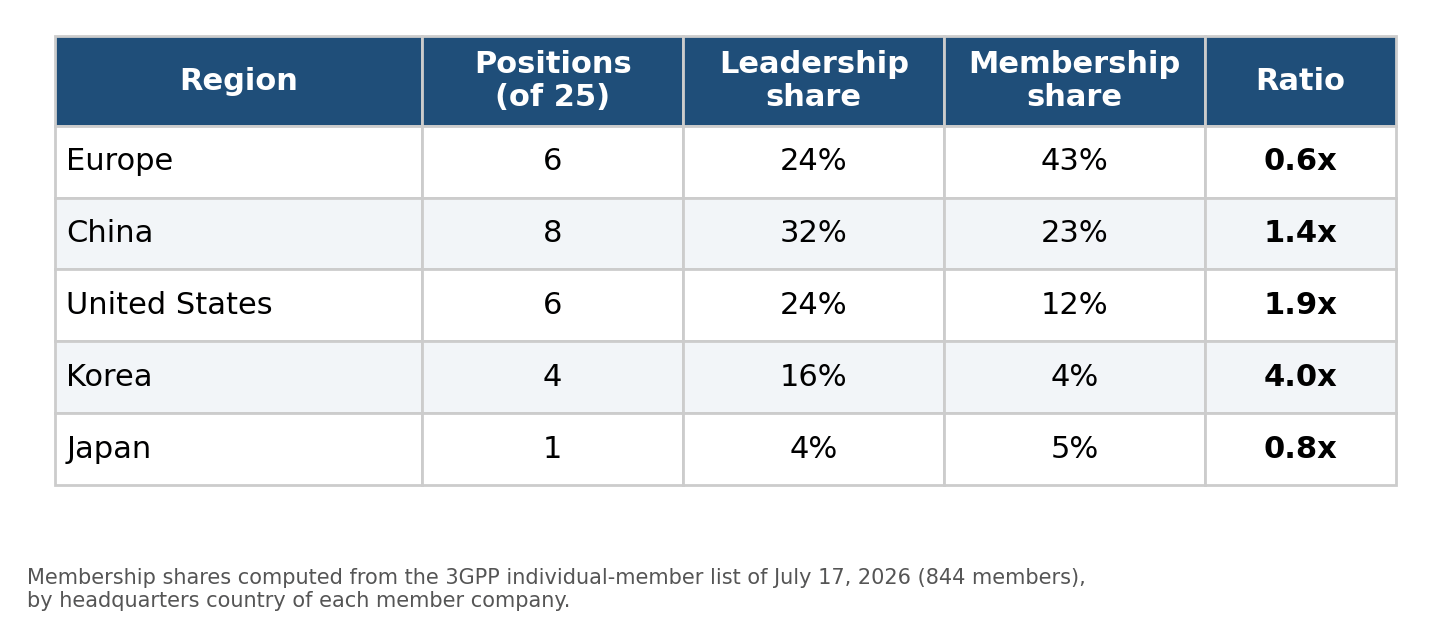
Membership shares are computed from the 3GPP individual-member list of July 17, 2026 (844 members), by the headquarters country of each member company.
What’s important to realize is not one of those positions was allocated to a country. Samsung holds the most chairs of any company on Earth, including TSG RAN itself, and it did not win them because Korea signed a statement with 25 other countries. It won them because Samsung out-contributes nearly everyone; Korea converts 4 percent of the membership into 16 percent of the leadership, four times its weight. Europe holds 43 percent of the membership and converts it into 24 percent of the leadership, because membership headcount is not contribution, and headcount is the one asset a coalition of governments can actually increase.
In March 2025, at the height of the sanctions against select Chinese companies, Huawei’s Peter Schmitt was re-elected chair of TSG Core Network and Terminals. By acclamation. Unopposed, in a body whose voting members include every major American firm. The delegates who could have run a candidate against him, or simply voted no, did neither, because he had earned the room’s trust across two decades of work. Whatever levers the 25 governments believe they hold over the creation of 6G, the election of Mr. Schmitt is the measurement of those levers, and the measurement is zero.
Look next at which American companies have earned leadership positions. Intel, a chip maker, chairs TSG SA. Qualcomm, another chip maker, chairs CT1. InterDigital, a research and licensing company, chairs both RAN2 and SA6. Apple, a device and chip maker, chairs RAN4. Every US-held chair belongs to a chip, device, or licensing company, and not one belongs to a network operator. AT&T’s lone vice-chair seat is it. This is not an accident. It is a map of who can still justify the investment. Standards contribution is a multi-year investment recovered through through standard-essential patent (”SEP”) licensing, and since eBay v. MercExchange stripped reliable injunctive relief from US patent law, with Patent Trial and Appeal Board exposure compounding the harm to patent holders, the expected return on a contributed invention has fallen for every American participant. The firms still at the table are the ones that recover the investment through chips, devices, or licensing royalties. The operators, who once anchored US influence, did the math and left. The participation gap the Call highlights downstream was priced upstream, in US enforcement policy.
There is a second domestic constraint the coalition strategy ignores. US law deliberately keeps the federal government out of standards authorship. The National Technology Transfer and Advancement Act (”NTTAA”) directs agencies to adopt privately developed voluntary consensus standards rather than write their own, and Office of Management and Budget Circular A-119 implements that directive. The hinge between the two layers is a Memorandum of Understanding (”MOU”) between the American National Standards Institute (”ANSI”) and the National Institute of Standards and Technology (”NIST”), first signed in 1998 and renewed several times thereafter. NIST, part of the Department of Commerce, is the government’s standards agency, and its job is to coordinate federal participation in the private system. ANSI, a private federation, runs the system itself: it accredits the standards developers, approves American National Standards, and, by NIST’s own recognition in the MOU, holds the United States’ seat at the International Organization for Standardization. The national standards body of the United States is a private nonprofit, and the government’s own standards agency formally recognizes it as the system’s coordinator and as America’s voice abroad. This architecture is a choice, made repeatedly over three decades, and it has served the country well. A strategy that asks the US government to “lead” in the authorship layer is asking it to lead in the one layer its own statutes assign to the private sector.
The Call’s three-month deliverable comes due in late October 2026. Those are the same weeks in which the fall 3GPP meetings produce the first contribution ledgers of the 6G era, following the approval of the first 6G radio study at the recent June 2026 plenaries. Those ledgers are public. If the coalition is working, its effects will show up where influence actually lives: in the US share of technical documents submitted, in an American operator appearing on a contribution list, in US candidacies for the working group vice-chair seats that come open between now and 2027.
What would be more impactful seems trivial. Restore the expected return on contribution, which means addressing injunctive relief and PTAB exposure for standards-essential patents. Underwrite operator participation directly if the market will not. Keep pressing the AI-native network agenda, which is the one element of current US strategy with a live theory of victory, because it moves value toward the compute layer where American firms are strongest. And aim the coalition at the venues built for coalitions: the ITU, WRC-27 spectrum positions, certification regimes, procurement. Governments winning in government venues while companies are re-armed for the company venue is a coherent strategy. Governments declaring leadership over a venue that admits them only as ordinary members, one seat among 844, is not. NTIA itself is already a 3GPP member. What it lacks is not access. It is contributions.
I write this as an advocate. I have spent a career in standards and SEP licensing, my practice benefits from stronger enforcement, and readers should weigh that. But the disclosure cuts the other way too: people who work inside this system know which doors the keys fit. The 25 signatures are worth having. They are simply aimed at the wrong fight, and there is still time, before the freezing of the 6G standard, to focus where they can provide the most impact.